What Sharjah Banks Actually Look for Before Approving a Business Account
A trade license does not open a bank account. It merely permits the application. Banks in Sharjah conduct a separate, more granular review before approval, and most rejections can be traced to gaps founders were unaware of.
Whether a company is established through Sharjah Publishing City or another free zone authority, the license represents only the first step; account approval follows a distinct and more exacting process.
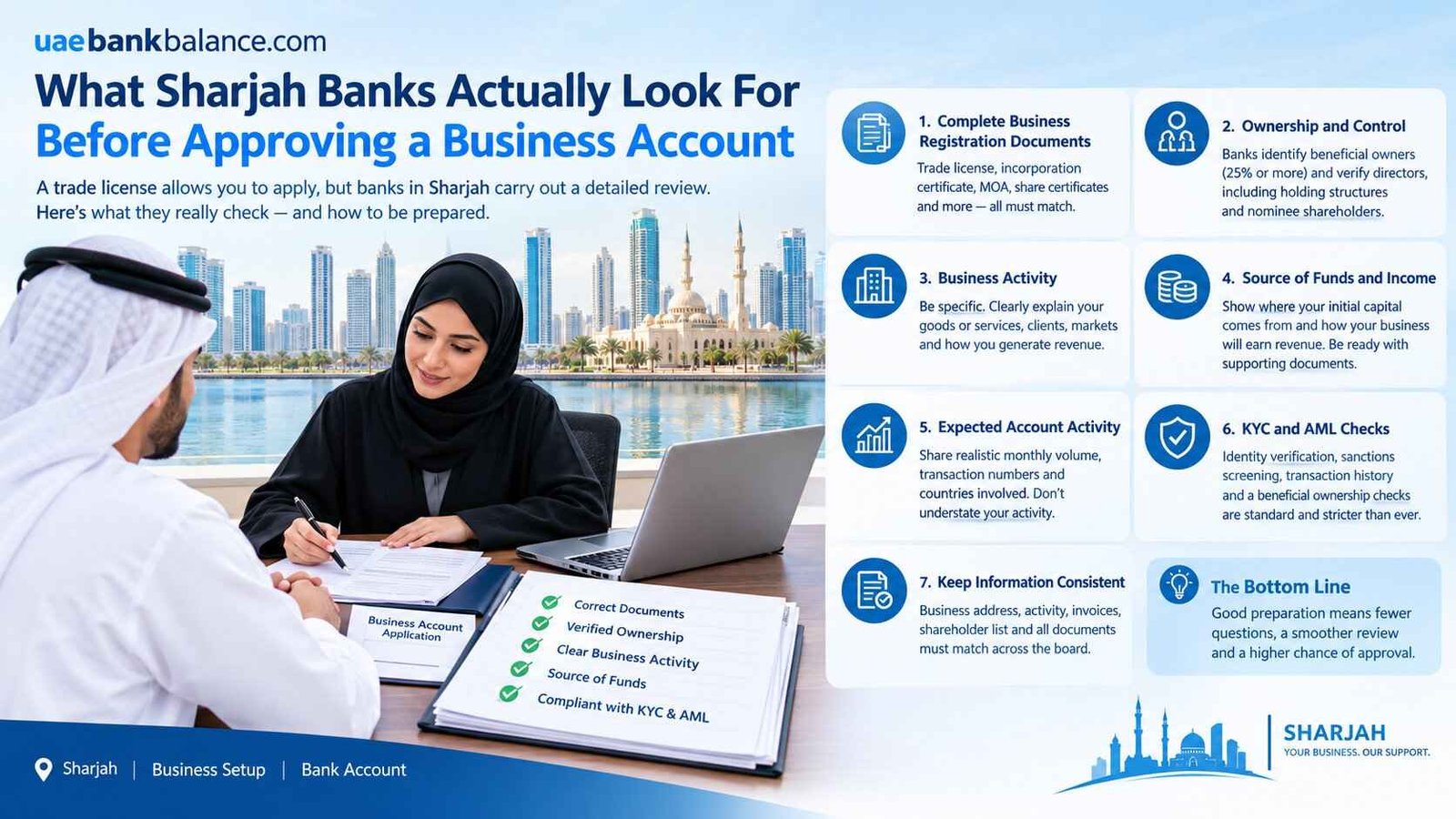
Start With Complete Business Registration Documents
Banks require a documentation trail that is fully consistent, not merely approximate.
This means the trade license, certificate of incorporation, memorandum of association, and share certificates must all corroborate the same set of facts.
A discrepancy as minor as an address variation across documents, or a slight inconsistency in the company name, can delay a file by several weeks. Compliance officers are not applying unnecessary rigour here; they are following protocols that treat inconsistency as a risk indicator until it is resolved.
For applicants pursuing a Sharjah Free Zone business setup, banks typically request:
- Valid trade license and certificate of incorporation
- Memorandum and Articles of Association
- Board resolution authorising the account opening
- Passport and visa copies of shareholders and signatories
- Proof of registered business address
These should be assembled and verified in advance of any bank meeting, not compiled reactively during it.
Understand Who Owns and Controls the Company
This is where a considerable number of applications stall.
Banks operating in the UAE are required to establish beneficial ownership, identifying the individuals behind the corporate structure rather than accepting the listed entity at face value.
When a company involves a holding structure, nominee shareholders, or ownership distributed across multiple jurisdictions, the bank will generally request written clarification along with supporting documentation. This is frequently underestimated.
Banks must identify and verify every individual who owns or controls 25% or more of the company’s capital or voting rights, and layered structures without a clear explanation are more often flagged than approved.
Director information carries comparable weight. Banks need to establish who holds signing authority, who makes decisions, and who bears accountability should complications arise.
Be Clear About Your Business Activity
Ambiguous descriptions generate more friction than accurately disclosed risk.
A trade license listing “general trading” provides a compliance officer with limited usable information, and vague filings tend to invite closer scrutiny rather than avoid it.
Banks expect specificity:
- The nature of goods or services offered
- The client base served
- The markets of operation
- The mechanism by which revenue is generated
This is particularly relevant for company formation in the UAE where the business involves cross-border trade, digital services, or consulting, because the underlying activity is not readily observable and the bank relies primarily on the applicant’s own account.
During company formation in Sharjah Free Zone, write the business activity description for a reader with no prior knowledge of the industry, then make sure your account activity backs it up. Take a consulting firm. If its account shows regular payments from clients for advisory work, everything lines up. If it starts receiving large, unexplained transfers that have nothing to do with consulting, the bank will want to know why. Where a compliance analyst has to guess, delays usually follow.
Show Where the Business Money Comes From
Source of funds and source of income are related concepts, though not interchangeable, and banks may ask about both.
Source of funds pertains to the capital used to establish the company, whether derived from savings, an asset sale, or investor contribution. Source of income pertains to how the business intends to generate revenue on an ongoing basis. Banks verify these claims against financial records, and inconsistencies at this stage are among the more common triggers for manual review.
Where initial capital originated from the sale of a prior business, the bank may ask for the sale agreement. Where it originated from a previous employment settlement, the bank may ask for the settlement documents. These requirements are not intended as intrusive; they reflect obligations under AML regulation, and unsupported claims are generally treated as unverified.
Explain Expected Account Activity
Banks construct a profile of anticipated “normal” activity before a single transaction has occurred.
This is the function served by expected transaction volume: the monthly value of funds moving through the account, the anticipated number of transactions, and the jurisdictions involved in incoming or outgoing transfers. Some founders understate these figures deliberately, under the assumption that a lower projection appears less risky. This assumption is generally incorrect. It typically results in the account being flagged once actual activity exceeds the declared profile, creating a separate complication.
A realistic forecast is preferable. Banks generally favour an accurate projection over a conservative estimate that is quickly surpassed.
Meet KYC and AML Compliance Checks
Customer due diligence is not a single gate to pass through; it constitutes an ongoing element of the banking relationship.
KYC requirements encompass identity verification, confirmation of business legitimacy, and screening against sanctions and politically exposed persons lists. AML screening examines transaction patterns, banking history, company ownership details, beneficial ownership information, and any structural characteristics associated with shell company arrangements.
None of this is specific to Sharjah; it is standard practice across UAE banking institutions. However, enforcement has become considerably more stringent in recent years, and incomplete applications are afforded less latitude than they once were.
Follow-up requests after initial submission should be anticipated as standard procedure, not interpreted as a sign of concern.
Make Business Information Consistent
Every document, form, and communication with the bank should present an identical account of the business, keeping transaction history consistent.
The business address stated on the trade license should correspond with the tenancy contract. The declared business activity should align with issued invoices. The shareholder list should match the Memorandum of Association precisely. Compliance teams cross-reference these details systematically, and inconsistency, even where unintentional, is typically interpreted as a risk indicator rather than a clerical oversight.
Preparing for a Smoother Account Opening
None of this diligence is arbitrary for company formation in UAE. Banks operate within a regulatory framework that holds them directly accountable for the clients they onboard, and the resulting scrutiny is structural rather than discretionary.
Founders who prepare documentation, establish ownership clarity, shareholder information clarity, and articulate business activity in advance of the first meeting find the process easier to manage, because accurate and consistent information leaves the bank fewer questions to ask. Those who treat the process as routine paperwork to be completed quickly tend, in most cases, to repeat it.
Safety Note: UAEBankBalance.com is an informational platform only. We are not a bank, financial institution, or business account provider. The information in this article is for general guidance and does not guarantee business bank account approval. Always verify the latest requirements directly with your chosen UAE bank or free zone authority.