Choosing the Right Savings Account for UAE’s Affluent Investors
Private bank deposits in the UAE grew 14.4% in a single year, according to UAE Central Bank data, outpacing the wider economy as wealthy residents and relocating high-net-worth individuals continue to build up cash reserves in the country. Yet a large amount of that cash still sits in accounts earning little to nothing, simply because a standard current account and a purpose-built savings account are often treated as interchangeable.
For affluent investors, that gap matters more than it seems. This blog looks at what actually separates a basic savings account from one built for larger balances, how tiered interest structures work, and what UAE’s affluent investors should check CIO-led multi-asset portfolios before choosing where to park their cash.
Why a standard savings account often falls short for larger balances
Most everyday savings accounts pay a flat rate, or close to it, regardless of how much sits in the account. For an affluent investor holding a significant cash balance, that structure leaves real money on the table, since the account pays the same rate whether the balance is AED 50,000 or AED 5 million.
How tiered interest actually works
A high interest savings account built for larger balances typically uses a tiered structure instead. Rather than one flat rate, the account pays progressively higher rates as the average monthly balance crosses set thresholds. This rewards investors for consolidating cash into one account rather than spreading it thinly across several lower-yielding ones.
Take this example
- An investor holds AED 800,000 in a standard savings account paying a low flat rate
- Moving that same balance into a tiered account where the 2.75% p.a. band applies from AED 500,000 changes the return meaningfully over a year
- The difference is not from taking on more risk, it comes purely from where the same cash is held
What UAE’s affluent investors should look for
1. Where the meaningful tiers actually start
Some accounts advertise a headline top rate that only applies to balances most people will never hold. What matters more is where the first meaningful tier begins, since that is the threshold most investors will actually cross.
2. Currency options
Affluent UAE investors often hold savings in more than one currency, particularly USD given regional business and investment ties. A savings account offering tiered rates in both AED and USD avoids the need to manage two separate relationships.
3. Minimum opening deposit and balance limits
High interest savings accounts typically require a higher minimum opening deposit than a standard account, and often cap the maximum balance eligible for profit. Both are worth checking against how much cash you actually plan to hold.
4. Access and liquidity
A savings account is only useful if it does not get in the way of everyday banking. Look for free 24-hour access across online, mobile, ATM, and branch channels, rather than a account that locks funds away like a fixed deposit.
5. Shariah compliance, where relevant
For investors who prefer Shariah-compliant banking, it is worth confirming this upfront, since not every high interest savings account is structured this way by default.
Indicative tiered profit rates on a UAE high interest savings account
Rates and thresholds vary by bank and change over time, but the table below illustrates how a typical tiered structure is shaped across AED and USD balances.
| Currency | Monthly Average Balance | Indicative Profit Rate |
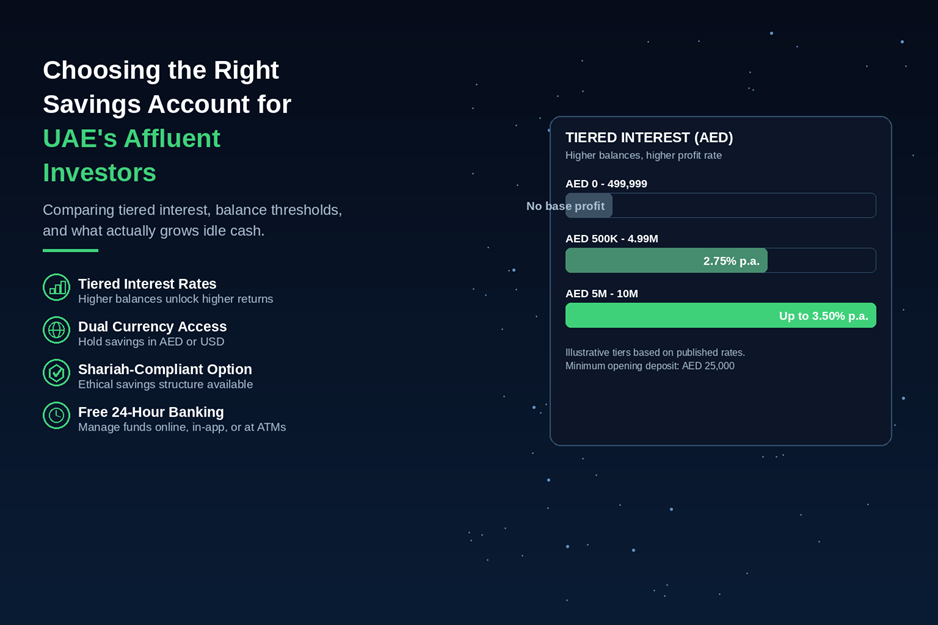
| AED | Below AED 500,000 | No base profit |
| AED | AED 500,000 to 4,999,999 | 2.75% p.a. |
| AED | AED 5,000,000 to 10,000,000 | Up to 3.50% p.a. |
| USD | Below USD 100,000 | No base profit |
| USD | USD 100,000 to 199,999 | 1.25% p.a. |
| USD | USD 500,000 to 999,999 | 2.50% p.a. |
| USD | USD 2,000,000 to 2,500,000 | 2.75% p.a. |
Rates shown are indicative of published tiered structures and are subject to change. Always confirm current rates directly with the provider before opening an account.
A simple way to think about consolidating cash
Here is an example
- An investor holds AED 300,000 in one bank and AED 400,000 in another, both earning close to nothing
- Neither balance individually reaches a meaningful tier threshold on its own
- Consolidating both into a single account brings the combined AED 700,000 into a higher profit tier
- The investor earns more on the same total cash, without changing how liquid or accessible it is
Things to check before switching savings accounts
- Confirm whether profit is calculated on the average balance or the closing balance, since this changes how much a fluctuating balance actually earns
- Ask how often profit is credited, monthly crediting compounds faster than quarterly or annual crediting
- Check whether the advertised top rate is realistically achievable for your balance, not just for the highest tier
- Review any fees tied to falling below a minimum balance
Making idle cash work harder
For UAE’s affluent investors, the difference between a standard savings account and one built for larger balances is not a marginal detail, it can be a meaningful amount of return earned simply by holding cash in the right place.
Standard Chartered’s Wealth$aver account is a high interest savings account designed around exactly this need, offering:
- Tiered profit rates of up to 3.50% p.a. on AED balances and up to 2.75% p.a. on USD balances
- Availability in both AED and USD, with profit calculated monthly on the average balance
- A Shariah-compliant savings structure
- Minimum opening deposit of AED 25,000, with balance limits up to AED 10 million and USD 2.5 million
- Free, 24-hour banking access online, via mobile, at ATMs, and in branch
- Access to Priority Banking benefits, including wealth solutions and market insights
Choosing the right savings account is one of the simplest ways for affluent UAE investors to put idle cash to work, without taking on any additional investment risk.
Disclaimer: UAEBankBalance.com is an independent informational website and is not a bank, lender, or government authority. Information is for general guidance only and may change. Always verify important details with the relevant bank or official service provider. Never share your OTP, passwords, card details, or other sensitive information with anyone claiming to represent this website.