UAE Bank Accounts: What Americans Need to Report to the US
Americans living in the UAE should review their bank accounts for US reporting, even when those accounts earn little interest. A salary account, emergency fund and savings deposit can create obligations separate from an income tax return.
Checking your balance through a banking app is useful for budgeting. For US compliance, however, today’s available balance is only part of the picture. Account ownership, balances during the year and income received all matter.
Does a UAE bank account need US reporting?
A UAE account may need to be reported because it is held outside the United States.
US citizens generally remain subject to US tax rules on worldwide income while living abroad. Whether an income tax return is required depends on income, filing status and other circumstances. Foreign account reporting has its own tests.
The distinction is practical: reporting an account does not mean the entire balance becomes taxable income. Money already saved, transferred between your accounts or borrowed is different from newly earned interest or wages.
Keep records explaining substantial deposits so their source is clear.
Check combined balances before dismissing the FBAR
The FBAR threshold generally applies across reportable foreign accounts, rather than separately to each bank.
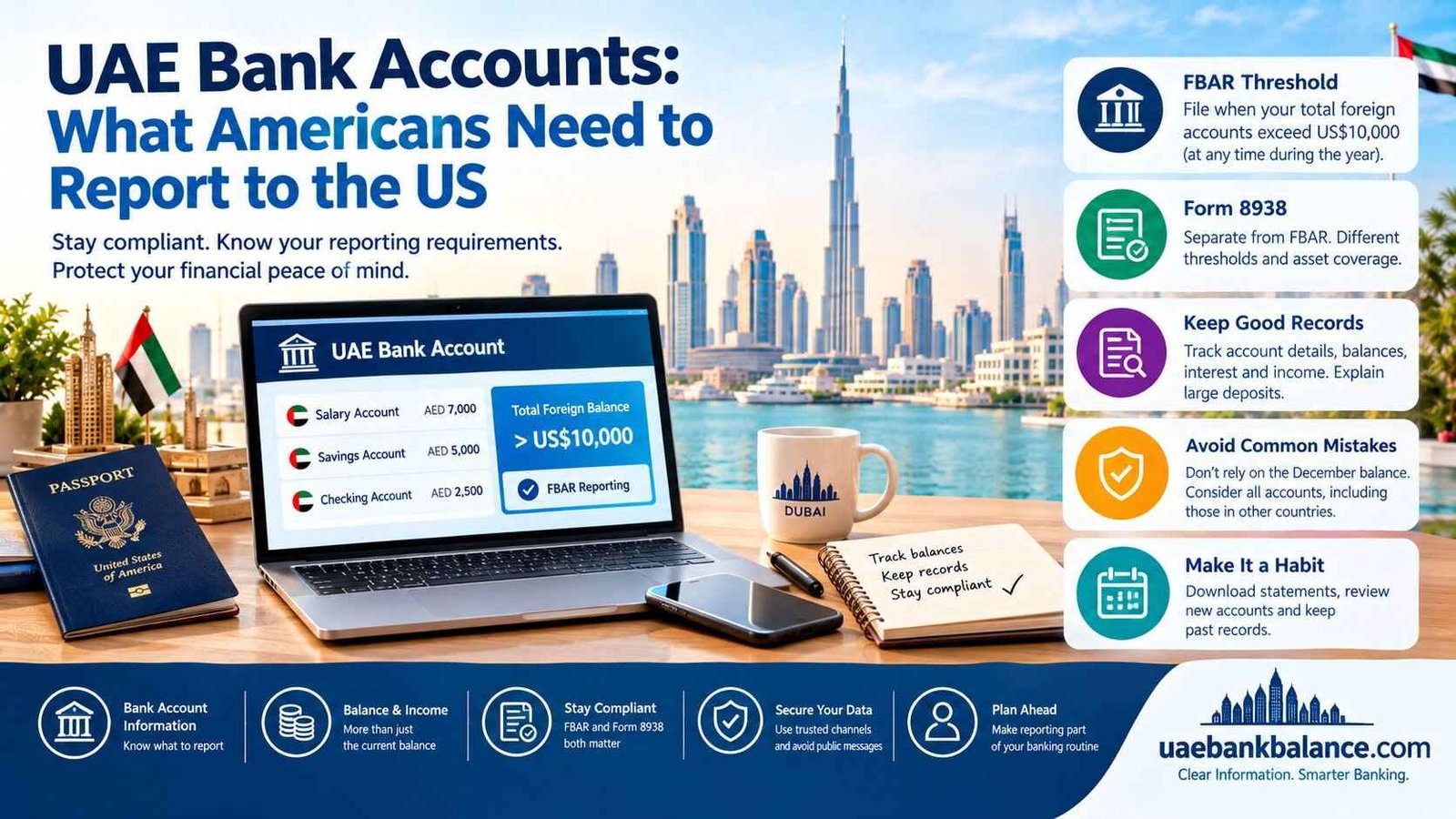
Under the IRS foreign account reporting guidance, a US person generally must file an FBAR when they have a financial interest in, or signature authority over, foreign financial accounts with an aggregate value exceeding US$10,000 at any time during the calendar year.
Consider a hypothetical American in Dubai with the equivalent of US7,000inasalaryaccountandUS5,000 in savings at the same time. Neither account exceeds US$10,000 individually, but together they exceed the threshold.
Accounts outside the UAE count too. Include relevant holdings in other countries when reviewing the requirement.
A temporary deposit can matter
A balance does not need to stay above the threshold throughout the year.
A bonus, property transaction or transfer for upcoming expenses may temporarily increase the amount held overseas. Looking only at the December statement could miss that event.
Download statements regularly and retain records for accounts you close. Banking apps may make current balances easy to see while older information takes longer to obtain.
For FBAR preparation, identify each account’s maximum annual value in its currency, then apply the required year-end Treasury exchange rate, where available. Income tax currency calculations follow separate rules.
Form 8938 requires another assessment
Filing an FBAR does not automatically satisfy Form 8938 requirements.
Form 8938 covers specified foreign financial assets and is attached to an income tax return when required. Its thresholds depend on filing status and whether the taxpayer qualifies as living abroad. Its asset coverage also differs from the FBAR.
Ask your preparer to assess both requirements. Do not assume that submitting account information through one process completes every disclosure.
A broader US-UAE Tax Guide for expats can help connect these banking questions with your overall US filing responsibilities. Check that any figures you use apply to the relevant tax year.
Build a useful banking record
An organised account list makes it easier to identify missing information before preparation begins.
For each account, record:
- The bank’s name and address.
- The account number and currency.
- Whether ownership is individual or joint.
- Opening and closing dates.
- Maximum balances and interest received.
- Any authority to sign over someone else’s account.
Joint ownership deserves attention even if your spouse usually manages the money. Similarly, authority over an employer’s account may warrant review, although exceptions can apply.
Share sensitive records through a secure portal. Avoid sending account numbers or identity documents through public messages.
Make reporting part of your banking routine
Before switching banks, download statements and confirm how to access historical records. When opening another savings account, add it to your list immediately. Keep confirmation of closed accounts, too.
Keep income tax preparation and account reporting as separate checklist items. The FBAR is filed electronically with FinCEN, separately from the federal income tax return.
If you discover missing past reports, assess the appropriate correction route before submitting them. A short review now can establish what is outstanding and which documents you need, making future banking and filing easier to manage.
Safety Note: This article is for general informational purposes only and is not tax, legal, or financial advice. U.S. citizens and other U.S. persons living in the UAE may have separate foreign-account reporting obligations, including FBAR and, in some circumstances, Form 8938. Reporting thresholds, filing requirements, exceptions and deadlines can depend on your individual circumstances and the relevant tax year. Always verify the latest requirements through the IRS and FinCEN, or speak with a qualified U.S. international tax professional before filing or correcting a report.