Best Tips for Managing Your MT5 Synthetic Indices Account
It is not enough to simply execute your trades and hope for favorable outcomes to properly manage your MT5 synthetic index account. While the MT5 synthetic indices account presents opportunities for you to trade regardless of economic conditions, it also requires you to be disciplined and to manage risk properly. Applying proper account management practices will enable you to protect your capital and trade consistently regardless of your experience. This article explains how to trade with more confidence and without unnecessary losses thanks to proper risk management principles.
Here is a guide for managing your MT5 synthetic indices account:
Manage Your Risk Per Trade
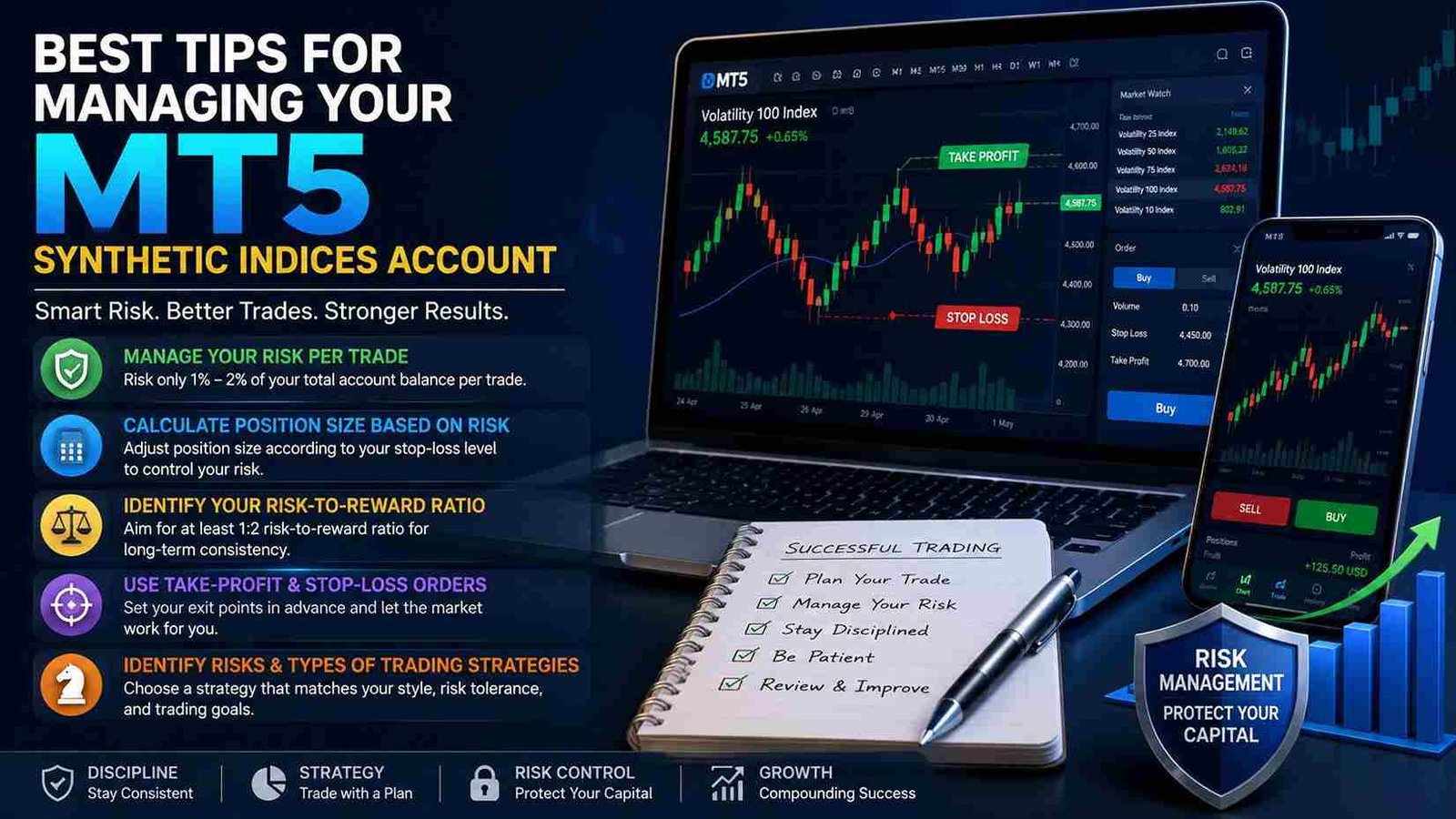
One of the most effective ways of ensuring the safety of your MT5 synthetic indices account is limiting the amount of money you risk per trade. Usually, professional traders do not risk more than 1% to 2% of their total account balance per trade. Even when making several losses in a row, this technique helps preserve your capital. You need to pay attention to consistency instead of trying to win big using high-risk positions. Disciplined risk management is still crucial, regardless of the synthetic indices broker employed.
Calculate Position Size Based on Risk
Locating a good trading setup is important when using an MT5 synthetic indices account, but so is determining the right size for that position. Instead of simply guessing, trades should be analyzed based on pre-set levels of risk. While a tighter stop-loss setting can allow a trader to enter a slightly bigger position without increasing his overall risk, the longer the stop-loss is, the smaller the position should be. It becomes much simpler thanks to the position calculators built into the platforms of many brokers that offer synthetic indices.
Identify Your Risk-to-Reward Ratio
There must be a balance between the possible gains and losses in any transaction. It is a common practice to ensure that there is at least a 1:2 risk-to-reward ratio where the reward is twice the risk amount. Despite the high risk-to-reward ratio, it is still possible to achieve good results in the long run even when you win in half of your transactions. The best way for traders to decide on their stop losses and target profits before entering any position in an MT5 synthetic indices account is to compare different brokers for synthetic indices. You can check out Syntxwiki to explore technical analysis techniques, market trends, and fundamentals that drive synthetic index price movement.
Using Take-Profit and Stop-Loss Orders
Trading through an MT5 synthetic indices account does not involve emotional decisions in terms of take-profit and stop-loss orders. Take-profit ensures profit when the target is hit, while the latter automatically ends the transaction when there is a move against the trade beyond the set amount. Without such measures, traders tend to end profitable transactions prematurely or keep losing ones for an unnecessarily long period. It is necessary to have preset exit points before engaging in the transaction. Choosing a list of brokers that trade synthetic indices will ensure proper execution of orders in volatile conditions.
Identify Risks and Types of Trading Strategies
There are a lot of trading strategies, such as scalping, swing trading, trend trading, and breakout strategies, that can be used on an MT5 synthetic indices account. Even if there are many trading opportunities in scalping, the strategy requires quick decision-making and strict discipline. Swing trading keeps your trades exposed to bigger market moves while reducing the frequency of trading. Traders need to assess their trading instruments, the stability of the platform, execution speed, and education before selecting the best broker for synthetic indices.
Conclusion
Self-discipline, determination, and a proper risk management strategy are required for managing an MT5 synthetic indices account successfully. Apart from this, it is equally important to understand the strengths and weaknesses of different trading strategies and select brokers that have synthetic indices. The strategies help traders protect themselves and perform consistently in the synthetic index market.
Disclaimer: Trading synthetic indices involves significant financial risk and may not be suitable for all investors. This article is for informational purposes only and should not be considered financial, investment, or trading advice.