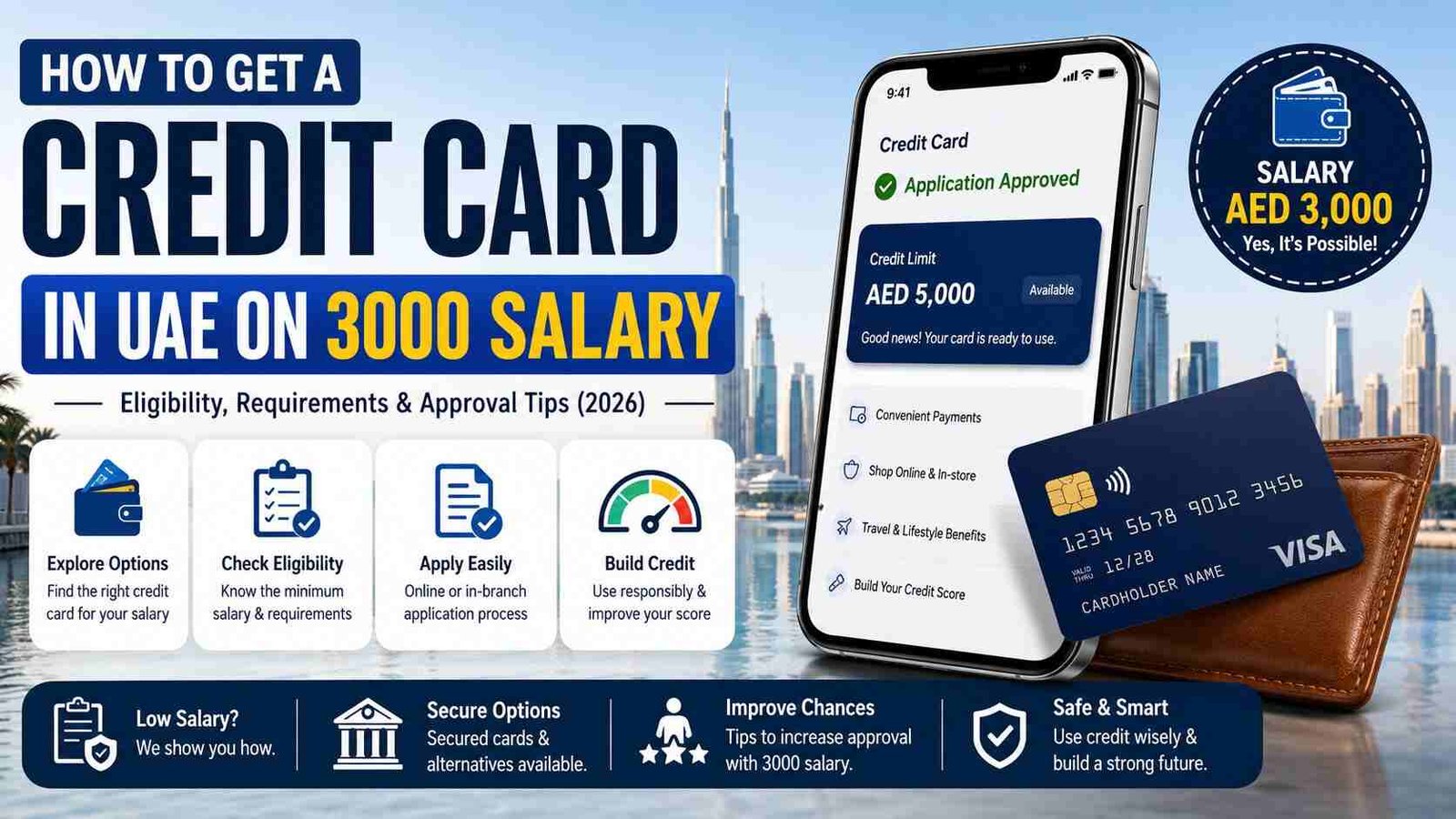
How to Get a Credit Card in UAE on 3000 Salary (2026 Complete Guide)
Getting a credit card in the UAE with a monthly salary of AED 3,000 is one of the most searched financial questions among residents, especially first-time workers, employees under the Wage Protection System (WPS), and expatriates. If you’ve searched “How to Get a Credit Card in UAE on 3000 Salary”, you’re probably wondering whether it’s even possible or if every bank will reject your application.
The short answer is that getting a standard unsecured credit card with a salary of AED 3,000 can be challenging, as many UAE banks set higher minimum salary requirements. However, that doesn’t mean you have no options. Depending on your employer, salary transfer arrangement, banking relationship, credit history, and whether you’re willing to provide a security deposit, there are still practical ways to access credit.
Many applicants make the mistake of applying to multiple banks without understanding the eligibility criteria. Multiple rejected applications can reduce your chances of approval because every application may be recorded in your credit history. Instead of applying blindly, it’s better to understand how UAE banks assess applications and choose the right option from the beginning.
This guide on UAEBANKBALANCE.COM explains everything you need to know about getting a credit card in the UAE with a 3000 salary, including bank requirements, eligibility criteria, secured credit cards, salary transfer options, required documents, approval tips, and common reasons applications are rejected. By the end of this guide, you’ll know which options are realistic and how to improve your chances of approval.
Can You Get a Credit Card in UAE on a 3000 Salary?
Yes—but with certain limitations.
Most banks in the UAE prefer applicants with higher monthly incomes because credit cards are unsecured borrowing products. Before issuing a card, banks evaluate whether the applicant has enough disposable income to repay outstanding balances every month.
Since AED 3,000 is below the minimum salary requirement for many premium and standard credit cards, approval becomes more difficult. However, approval isn’t based on salary alone.
Banks usually evaluate several factors together, including:
- Monthly salary
- Employer category
- Employment stability
- Existing loans
- Credit history
- Salary transfer relationship
- Debt obligations
- Nationality and residency status
If these factors demonstrate lower financial risk, some banks may consider entry-level products or alternative credit solutions even when the applicant earns AED 3,000 per month.
It’s important to understand that every bank follows its own internal lending policies. Meeting the salary requirement alone does not guarantee approval, and earning less than the preferred salary does not automatically mean rejection in every case.
Why Do UAE Banks Have Minimum Salary Requirements?
Many people assume banks set minimum salary requirements simply to limit who can apply. In reality, these requirements are part of the bank’s risk management process.
A credit card allows customers to borrow money without providing collateral. Because the bank carries the financial risk, it wants to ensure that applicants have sufficient income to repay their outstanding balances on time.
Applicants with higher incomes generally have greater repayment capacity, making them lower-risk borrowers. Those with lower incomes may have less disposable income after covering rent, transportation, food, and other living expenses.
Banks also review the applicant’s overall debt burden. If a large percentage of monthly income is already committed to loans or other financial obligations, approving additional credit may increase the risk of default.
These salary requirements are designed to promote responsible lending while helping both banks and customers avoid excessive debt.
Minimum Salary Requirement for Credit Cards in the UAE
The exact minimum salary requirement depends on the issuing bank and the type of credit card.
Entry-level cards generally have lower salary requirements than premium travel or cashback cards, while exclusive lifestyle cards often require significantly higher incomes.
The table below provides a general overview of common salary expectations across different categories of UAE credit cards.
| Credit Card Type | Typical Minimum Salary |
|---|---|
| Entry-Level Credit Cards | Around AED 5,000 (varies by bank) |
| Cashback Credit Cards | Often AED 5,000–8,000 |
| Rewards Credit Cards | Usually AED 5,000 or above |
| Premium Cards | AED 10,000 or higher |
| Elite Cards | AED 20,000+ depending on issuer |
These figures are general market observations and individual banks may apply different eligibility criteria.
Therefore, applicants earning AED 3,000 should focus on realistic alternatives instead of premium credit card products.
Best Options for Getting a Credit Card on a 3000 Salary in the UAE
Most UAE banks require a minimum salary of AED 5,000 or more for standard unsecured credit cards. If your monthly salary is AED 3,000, your options are usually limited to secured credit cards, relationship-based offers, or products offered at the bank’s discretion after an internal assessment.
| Bank | Typical Minimum Salary for Standard Credit Cards* | Alternative for AED 3,000 Salary |
|---|---|---|
| FAB | From AED 5,000 (varies by card) | Ask about secured credit cards or relationship-based products |
| Emirates NBD | From AED 5,000 (varies by card) | Secured card may be available for eligible customers |
| ADCB | From AED 5,000 (varies by card) | Check secured credit card eligibility |
| Mashreq | From AED 5,000 (varies by card) | Eligibility depends on internal assessment |
| NBF | From AED 5,000 (varies by card) | Secured credit card against a qualifying fixed deposit |
*Minimum salary varies by the specific credit card product and bank policy.
Important: There is currently no major UAE bank that publicly advertises a standard unsecured credit card with a minimum salary requirement of AED 3,000. Approval is always subject to the bank’s eligibility criteria, internal credit assessment, and applicable terms.
Eligibility Criteria for a UAE Credit Card
Every bank has its own internal approval policies, but most institutions evaluate similar factors before deciding whether to approve a credit card application.
Common eligibility requirements include:
- Valid Emirates ID.
- UAE residence visa (for expatriates).
- Minimum age requirement, usually 21 years or above.
- Stable monthly income.
- Proof of employment.
- Good repayment history.
- Acceptable credit profile.
- Compliance with the bank’s lending policies.
Meeting these requirements improves your chances of approval, but the final decision always depends on the bank’s internal assessment.
Documents Required to Apply
Preparing all necessary documents before submitting your application helps speed up the approval process and reduces delays.
Most UAE banks typically request:
| Required Document | Purpose |
|---|---|
| Emirates ID | Identity verification |
| Passport Copy | Personal identification |
| UAE Residence Visa | Residency confirmation |
| Salary Certificate | Proof of monthly income |
| Recent Salary Slips | Income verification |
| Bank Statements (usually 3–6 months) | Financial assessment |
| Completed Application Form | Credit card request |
Some banks may request additional documents depending on your employer category, nationality, employment type, or the specific credit card you are applying for.
Step-by-Step Guide to Applying for a Credit Card
Applying for a credit card becomes much easier when you understand the process in advance.
Step 1: Compare Credit Card Options
Before applying, compare different banks and review their eligibility requirements.
Pay attention to:
- Minimum salary requirement.
- Annual fees.
- Cashback or rewards.
- Interest rates.
- Eligibility criteria.
- Additional benefits.
Applying only for cards that match your profile significantly improves your chances of success.
Step 2: Check Your Eligibility
Review the bank’s published requirements before completing an application.
If your salary is below the stated minimum, consider alternative options such as secured credit cards rather than submitting applications that are likely to be rejected.
Step 3: Prepare Your Documents
Gather all required documents before beginning your application.
Having complete documentation helps the bank process your application more efficiently.
Step 4: Submit Your Application
Applications can usually be submitted through:
- Official bank website
- Mobile banking application
- Customer service representative
- Bank branch
Always use official banking channels to protect your personal information.
Step 5: Verification Process
After receiving your application, the bank typically verifies:
- Identity
- Employment
- Salary details
- Credit history
- Existing financial obligations
The verification process helps determine whether the application meets the bank’s lending criteria.
Step 6: Approval Decision
If approved, the bank will inform you about your:
- Credit limit
- Card type
- Fees
- Activation instructions
- Delivery timeline
If the application is declined, avoid immediately applying to multiple banks without first understanding why the application was unsuccessful.
How Banks Evaluate Your Credit Card Application
Many applicants believe approval depends only on salary, but banks actually review your overall financial profile.
Some of the main factors considered include:
Monthly Income
Your monthly salary remains one of the most important approval factors because it indicates your repayment capacity.
Employment Stability
Applicants who have maintained stable employment for longer periods are generally viewed as lower-risk borrowers.
Employer Profile
Some employers have established payroll relationships with banks, which may positively influence the application process.
Existing Loans
Banks calculate your existing monthly financial obligations before approving additional credit.
Applicants with high debt commitments may receive lower credit limits or face rejection.
Credit History
Your repayment history plays an important role in determining whether you are considered a responsible borrower.
Late payments, defaults, or previous credit issues may reduce your chances of approval.
Banking Relationship
Customers who already use the bank’s salary account, savings account, or other financial products sometimes receive more favourable consideration during the approval process.
How to Improve Your Chances of Getting Approved
If your salary is AED 3,000, getting approved for a credit card requires careful planning. Instead of applying to every bank, focus on improving the factors that banks consider during their assessment. Even if you don’t qualify today, strengthening your financial profile can increase your chances in the future.
Maintain Stable Employment
Banks prefer applicants with stable employment because it indicates a regular source of income. If you’ve recently changed jobs, some banks may ask you to complete your probation period before considering your application.
Remaining with the same employer for a longer period may improve your overall financial profile and demonstrate employment stability.
Build a Good Banking Relationship
Having an active relationship with a bank can work in your favour. If your salary is credited into a bank account every month and you use the account responsibly, the bank gains a better understanding of your financial habits.
Avoid returned cheques, unpaid fees, or account irregularities. A healthy banking relationship reflects responsible financial management.
Pay Bills on Time
Late payments on loans, credit cards, telecom bills, or other financial obligations can affect your credit profile. Banks prefer applicants who have a history of making payments on or before the due date.
Setting reminders or enabling automatic payments can help you avoid unnecessary late payment records.
Avoid Multiple Credit Card Applications
One common mistake is submitting applications to several banks at the same time. If multiple banks reject your applications within a short period, it may negatively affect your credit profile.
Instead, research the eligibility criteria carefully and apply only to products that match your income and financial situation.
Reduce Existing Debt
If you already have a personal loan or other financial commitments, reducing your outstanding debt before applying for a credit card can improve your debt-to-income ratio. Lower financial obligations generally make applicants more attractive to lenders.
Consider a Secured Credit Card
If an unsecured credit card is difficult to obtain, a secured credit card can be an excellent alternative. Responsible use of a secured card over time may help establish a positive repayment history and improve your eligibility for future banking products.
Alternatives If You Cannot Get a Credit Card
If your application is declined, don’t assume you have no financial options. Several alternatives allow you to make purchases, manage your salary, and build financial discipline without relying on a traditional unsecured credit card.
Debit Cards
A debit card linked to your salary account allows you to withdraw cash, pay bills, shop online, and make purchases at retail stores. Since you spend only the money available in your account, there is no borrowing involved.
Prepaid Cards
Prepaid cards are another practical option. You load funds onto the card before using it for purchases, helping you control spending while enjoying many of the conveniences of card payments.
Secured Credit Cards
As discussed earlier, secured credit cards require a refundable security deposit. They are often easier to obtain than standard unsecured credit cards and can help build a positive credit history.
Digital Payment Wallets
Many UAE residents use digital wallets and mobile payment services for everyday transactions. These services allow you to make payments securely without carrying cash and are widely accepted at many retailers.
Common Mistakes to Avoid
Many applicants unknowingly reduce their approval chances by making avoidable mistakes during the application process.
Applying Without Checking Eligibility
Submitting an application without reviewing the bank’s minimum salary requirement often leads to unnecessary rejection. Always verify that you meet the eligibility criteria before applying.
Providing Incorrect Information
Ensure that all information on your application form matches your official documents. Incorrect employment details, salary information, or contact details may delay processing or result in rejection.
Ignoring Credit History
Some applicants focus only on salary while overlooking their credit report. Existing unpaid debts or previous defaults can significantly affect approval decisions.
Borrowing Beyond Your Means
A credit card should be used as a payment tool rather than a source of additional income. Spending more than you can comfortably repay can lead to financial stress and increased debt.
Safety Tips When Applying for a Credit Card
Applying for a credit card involves sharing sensitive personal and financial information. Protecting that information is essential.
Only apply through official bank websites, mobile applications, or authorized branches. Avoid unofficial websites or social media advertisements promising guaranteed approval regardless of salary.
Never share your One-Time Password (OTP), internet banking password, PIN, or Emirates ID details with unknown individuals. Legitimate banks will never ask for confidential security information through phone calls or messaging apps.
Before uploading documents online, verify that the website belongs to the official bank and uses a secure connection. Be cautious of phishing emails or fake websites that imitate financial institutions.
If someone claims they can guarantee credit card approval in exchange for an upfront payment, treat it as a potential scam. Approval decisions are made solely by the issuing bank based on its internal assessment.
Frequently Asked Questions
Can I get a credit card in the UAE with a salary of AED 3,000?
It may be possible in some situations, but many unsecured credit cards require a higher minimum salary. Some applicants may qualify for secured credit cards or other alternatives depending on the bank’s policies and their overall financial profile.
Which credit card is best for a 3000 salary?
There is no single best credit card for everyone. The right option depends on your income, employer, banking relationship, and eligibility. If you don’t qualify for an unsecured card, a secured credit card may be a practical alternative.
Will my credit score affect approval?
Yes. Banks often review your credit history when assessing your application. Maintaining timely payments and responsible financial behaviour can improve your chances of approval.
Can expatriates apply for a UAE credit card?
Yes. Expatriates living and working in the UAE can apply for credit cards, provided they meet the bank’s eligibility requirements, including residency, income, employment, and documentation.
How long does credit card approval take?
Processing times vary between banks. After submitting all required documents, approval may take anywhere from a few working days to longer if additional verification is required.
What happens if my application is rejected?
If your application is declined, ask the bank whether they can provide a general reason. Improving your financial profile, reducing debt, or waiting until your income increases may improve your chances before applying again.
Conclusion
Getting a credit card in the UAE on a 3000 salary requires realistic expectations and careful planning. While many banks have minimum salary requirements above AED 3,000 for standard unsecured credit cards, this does not mean you have no options. Secured credit cards, strong banking relationships, stable employment, and responsible financial management can all improve your eligibility over time.
Before submitting any application, compare different products, review the bank’s eligibility criteria, and prepare all required documents. Avoid applying to multiple banks without checking whether you qualify, as repeated rejections can negatively affect your credit profile.
Most importantly, remember that a credit card is a financial responsibility. Whether you qualify today or in the future, using your card wisely, paying your dues on time, and managing your finances responsibly will help you build a stronger financial future in the UAE.