How to Get a Credit Card in UAE on AED 4,000 Salary (2026 Guide)
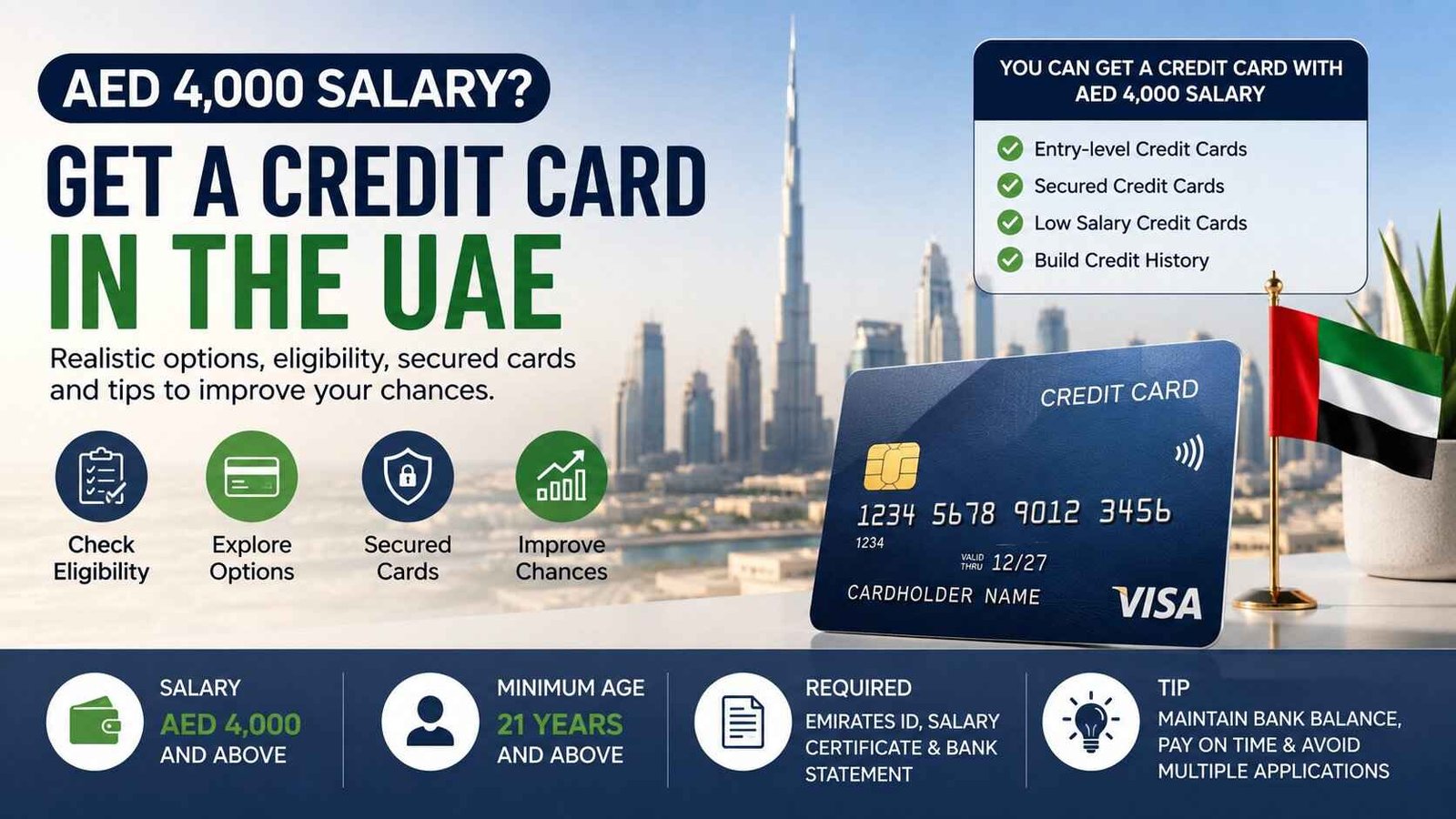
You earn AED 4,000 every month, your salary comes into your UAE bank account on time, you pay your bills, and yet when you search for a credit card, you keep running into the same problem: “Minimum salary AED 5,000.”
It can feel a little unfair. You may only want a card for online shopping, hotel bookings, emergencies or everyday payments — not a huge credit limit. But most standard UAE credit cards are designed around income and affordability requirements, so simply applying to one bank after another usually isn’t the smartest approach.
The good news is that AED 4,000 does not mean you have no options at all.
The important part is understanding which options are actually realistic. A standard unsecured card may not be available at your current income, but there are other routes worth checking, including deposit-backed cards, your existing salary-bank relationship, supplementary cards and non-credit alternatives.
This guide takes a practical approach. Instead of promising that a particular bank will approve an AED 4,000 salary, we’ll look at which UAE banks and card routes you should check, what to ask for, and what to do if you don’t meet the advertised salary requirement.
Safety note: Never use a fake salary certificate, altered payslip or agent who promises guaranteed credit-card approval. UAE lenders assess affordability and credit information before extending credit. For the official rules, check the CBUAE Credit Card Rules.
Can You Get a Credit Card in UAE With AED 4,000 Salary?
The short answer is:
A normal unsecured credit card is generally not available at AED 4,000 under the CBUAE’s stated annual income threshold.
The CBUAE rulebook specifies a minimum annual income of AED 60,000, equivalent to AED 5,000 per month, for standard credit-card issuance. It also provides for cards to be issued against a pledged deposit of at least AED 60,000 for people who do not meet that income requirement.
That changes how you should approach the search.
Instead of asking:
“Which bank secretly gives credit cards to people earning AED 4,000?”
Ask:
“Which credit-card route fits my situation if my salary is AED 4,000?”
That is a much more useful question.
Top 10 Credit Card Options and Alternatives for AED 4,000 Salary in UAE
The following options are not a list of banks that are guaranteed to approve an AED 4,000 salary. They are the practical routes and banks worth checking, depending on your existing relationship, the specific card, and the bank’s current eligibility rules.
| Option | AED 4,000 salary | Best for |
|---|---|---|
| Emirates NBD | Check product eligibility; secured route may be relevant | Existing ENBD customers |
| ADCB | Check current card criteria and salary relationship | ADCB salary customers |
| FAB | Check current card eligibility | FAB salary-account holders |
| Emirates Islamic | Check current card/product criteria | Islamic banking customers |
| RAKBANK | Check current card requirements | Existing RAKBANK customers |
| CBD | Check product-specific eligibility | CBD customers |
| Sharjah Islamic Bank | Check current product requirements | SIB customers |
| Liv. by Emirates NBD | Check current product eligibility | Digital banking users |
| Supplementary card | Alternative to your own primary card | Family/spouse arrangements |
| Secured credit card | Main route below income threshold | Applicants able to provide security |
1. Emirates NBD Credit Card With AED 4,000 Salary
Emirates NBD is one of the first banks many UAE residents check when searching for a credit card.
But don’t make the mistake of assuming that because Emirates NBD has many different cards, one of them will automatically accept a AED 4,000 salary.
For example, Emirates NBD currently lists a AED 5,000 minimum salary for its Webshopper Credit Card, while its Titanium Credit Card also lists AED 5,000.
So if you earn AED 4,000, the smarter approach is to check your eligibility rather than submitting an application simply because the card looks suitable.
What should you do?
If your salary is already credited to Emirates NBD, contact the bank and ask:
“My monthly salary is AED 4,000. Which credit-card options am I currently eligible for, and is there a secured card option?”
That gives you a clear answer without wasting an application.
If you already use ENBD for your salary, you can also compare your banking needs with our UAE bank balance and salary guides.
Best for: Existing Emirates NBD salary customers who want to check their actual eligibility.
2. ADCB Credit Card Options for AED 4,000 Salary
ADCB is another obvious bank to check, particularly if your employer already transfers your salary there.
However, salary transfer does not automatically mean a bank must approve a credit card below its stated eligibility requirement.
Your salary relationship is useful because the bank already has an established relationship with you, but the exact card requirement still matters.
If your salary is AED 4,000, ask ADCB specifically whether:
- You qualify for any current credit-card product
- Your salary-transfer relationship changes your available options
- A secured/deposit-backed solution is available
- A debit or prepaid product would be more appropriate
Don’t rely on old articles claiming that ADCB “sometimes approves” AED 4,000 salaries unless the bank confirms it for the product you want.
Best for: Existing ADCB salary-account customers.
3. FAB Credit Card With AED 4,000 Salary
FAB is particularly relevant to UAE residents who receive their salary through a FAB account.
If you’re searching for a FAB credit card with AED 4,000 salary, start with the card’s current eligibility rather than looking for a generic “FAB minimum salary.”
Different products can have different requirements.
If your salary does not meet the requirement for the card you’re interested in, ask FAB whether there is another eligible product or whether a secured arrangement is available.
And if your actual problem is simply checking your salary credit, you may not need a credit card at all.
Our FAB Salary Check guide can help you check your salary information before approaching the bank.
Best for: FAB salary-account customers.
4. Emirates Islamic Credit Card Options
If you prefer Islamic banking, Emirates Islamic is another bank worth checking.
The important point is not to choose a card simply because someone online says it is a “low salary card.”
Instead, check the current eligibility for the exact Emirates Islamic credit card you want.
If AED 4,000 does not meet the product’s income requirement, ask whether another card or banking solution is available.
You should also compare the total cost of the card, not just the rewards.
A card offering cashback is not necessarily a good deal if you cannot comfortably repay the balance every month.
Best for: Customers who already bank with Emirates Islamic or prefer Shariah-compliant banking products.
5. RAKBANK Credit Card Options
RAKBANK is another name that frequently appears when UAE residents search for entry-level banking products.
If you already have a RAKBANK account and your salary is AED 4,000, check your current eligibility directly with the bank.
Do not assume that a particular RAKBANK card has the same salary requirement as another card.
A better conversation with the bank is:
“I earn AED 4,000 and my salary is credited to RAKBANK. Can you tell me which card products I am eligible for?”
If the answer is no, you have saved yourself from an unnecessary application.
Best for: Existing RAKBANK customers looking for an entry-level option.
6. CBD Credit Card Options
Commercial Bank of Dubai is another bank that UAE residents may consider, especially those who prefer digital banking.
The fact that a credit-card application can be completed digitally does not mean salary requirements disappear.
If you earn AED 4,000, check the current eligibility for the specific CBD card before applying.
If you don’t qualify, ask about alternative products instead of submitting multiple applications.
This is especially important for first-time card applicants who may be tempted by easy online application forms.
Best for: CBD customers and applicants looking for digital banking services.
7. Sharjah Islamic Bank Credit Card Options
Sharjah Islamic Bank can be considered by residents looking for Shariah-compliant banking.
Again, the important question is not whether SIB is “easy approval.”
The question is:
Does the particular card currently accept your income level?
If not, ask the bank about alternative products or other ways to access payment services without taking unsecured credit.
This approach also prevents a common mistake: choosing a financial product based on a blog’s old salary figure when the bank’s current requirement may be different.
Best for: Customers looking for Islamic banking products.
8. Liv. by Emirates NBD
Liv. is a digital-first banking brand associated with Emirates NBD, so it naturally attracts younger customers and people who prefer app-based banking.
If you are earning AED 4,000, you may come across Liv when searching for a low-salary credit card.
But don’t assume that opening a Liv account automatically makes you eligible for a credit card below the applicable income requirement.
Check the current product eligibility before applying.
If you don’t qualify for a credit card, Liv or another digital banking account may still be useful for everyday banking, even if it does not solve the borrowing requirement you originally had.
Best for: Digital-first users who want simple banking rather than necessarily borrowing.
9. Supplementary Credit Card
This is one of the most overlooked alternatives.
Suppose your spouse already has an eligible credit card.
Instead of trying to obtain your own primary card with a AED 4,000 salary, you could ask whether the issuing bank offers a supplementary card and whether you meet its conditions.
A supplementary card is linked to the primary cardholder’s account.
That means you should understand who is responsible for repayment before using it.
This option can be useful if your actual requirement is simply to have a card for:
- Online purchases
- Subscriptions
- Travel
- Hotel reservations
- Household spending
You may not need an independent credit facility at all.
10. Secured Credit Card — The Most Important Route Below AED 5,000
This is the option that deserves the most attention.
The CBUAE rules specifically state that people who do not meet the AED 60,000 annual income requirement can be issued a credit card against a pledged deposit of at least AED 60,000, subject to the applicable rules.
This is different from a normal unsecured credit card.
How does it work?
You provide the required deposit to the bank.
The deposit is pledged as security.
The bank issues a credit card according to its approved terms.
Your available credit is then governed by the bank’s product and the applicable regulatory limits.
The CBUAE rules also state that where an additional credit facility is provided alongside the card, the combined facility and card limit cannot exceed 50% of the pledged deposit.
Why this matters for AED 4,000 earners
If you genuinely need a credit card but your income is below the standard threshold, a secured structure may provide a legitimate route.
But there is a major catch:
AED 60,000 is a lot of money.
If that AED 60,000 is your emergency fund, rent money, family savings or money needed for other commitments, tying it up simply to obtain a credit card may be a poor decision.
A secured card is an option — not a recommendation for everyone.
Why Do UAE Banks Keep Asking for AED 5,000?
The reason you keep seeing AED 5,000 is straightforward.
The CBUAE credit-card rules specify a minimum annual income of AED 60,000 for standard credit-card issuance. That’s equivalent to AED 5,000 per month.
Banks can then set their own product-level policies.
For example, Emirates NBD currently lists AED 5,000 as the minimum salary for its Webshopper and Titanium cards.
So if you earn AED 4,000, you are not just one small application away from qualifying for every card.
You are below the standard income threshold.
That is why alternative routes matter.
What If Your Salary Is AED 4,000 but You Have Other Income?
This is where you need to be completely honest with the bank.
If you have legitimate, regular income in addition to your salary, tell the bank and ask whether that income can be considered under its policy.
Do not simply add an unofficial amount to your salary.
For example, don’t say you earn AED 5,500 if your salary certificate says AED 4,000 and you cannot document the difference.
If you have legitimate additional income, provide the documents requested by the bank.
The goal is not to “make your salary reach AED 5,000.”
The goal is to give the bank an accurate picture of your financial position.
Can Your Salary Bank Help You?
Yes, it is worth asking.
But there is an important difference between:
“My salary is with the bank.”
and
“The bank will approve my credit card.”
The first may help establish your banking relationship.
The second is never guaranteed.
Your salary bank is still a good first stop because it can tell you which products are currently available to you.
Ask about:
- Current credit-card eligibility
- Secured cards
- Entry-level cards
- Supplementary cards
- Debit-card alternatives
That conversation is much more useful than applying blindly.
Check Your Existing Debt Before Applying
A AED 4,000 salary can look very different depending on your existing commitments.
Someone earning AED 4,000 with no debt is in a very different position from someone earning AED 4,000 while paying:
- AED 1,200 car finance
- AED 500 personal loan
- AED 300 BNPL
- AED 200 existing card payments
The CBUAE rules require lenders to consider liabilities and income, with total instalments including credit-card payments subject to the applicable 50% limit of gross salary and regular income.
For AED 4,000, 50% would be AED 2,000.
But don’t interpret that as:
“I can safely spend AED 2,000 every month on credit.”
It is a regulatory ceiling, not a personal budgeting target.
Should You Apply to Five Banks at Once?
No.
This is one of the worst strategies for a person who already knows their salary is below the normal threshold.
If a card clearly requires AED 5,000 and you earn AED 4,000, applying to five similar cards will not magically change the requirement.
Instead:
- Check the current salary requirement.
- Check your existing liabilities.
- Ask your salary bank.
- Investigate secured or alternative products.
- Apply only when you have identified a realistic route.
That is a much cleaner strategy.
What Documents Might the Bank Ask For?
Depending on the product, you may be asked for:
- Emirates ID
- Passport
- UAE residence documentation
- Salary certificate
- Payslips
- Recent bank statements
- Employment information
- Additional documents requested by the bank
For example, Emirates NBD currently lists Emirates ID/passport documents, salary certificate and recent bank statements among the requirements for its Webshopper card.
The exact documents vary by bank and product.
What About a Credit Card After Your Salary Reaches AED 5,000?
This is where your choices become much wider.
Once your income reaches the relevant threshold, you can start comparing mainstream cards based on what you actually spend.
Cashback cards
Good if most of your spending is on groceries, fuel, utilities, telecom and everyday purchases.
Travel cards
More useful if you regularly fly, use airport lounges or spend internationally.
Shopping cards
Useful if you regularly shop with a particular retailer or want merchant-specific rewards.
Free-for-life cards
Good for people who don’t want to worry about annual fees.
For example, Emirates NBD currently advertises its LuLu 247 Titanium card with a AED 5,000 minimum salary and free-for-life positioning.
The important lesson is that AED 5,000 doesn’t mean you should immediately choose the first card you see.
Compare the card against your actual spending.
Is a Credit Card Worth It on AED 4,000 Salary?
Sometimes.
But I would ask one question before anything else:
What do you need the credit card for?
If the answer is:
“I need to borrow money because my salary doesn’t last until payday.”
Then a credit card could make the situation worse.
If the answer is:
“I need a card for online purchases, but I already have enough money in my account.”
Then a debit or prepaid card may solve the problem without borrowing.
If the answer is:
“I want to build a proper credit relationship.”
Then a legitimate secured option may be worth investigating if you can comfortably provide the required security.
The smartest financial decision is not always getting the credit card.
Sometimes it’s realizing that you don’t need credit in the first place.
AED 4,000 Salary Credit Card: What I Would Do First
If I were creating a practical checklist for someone earning AED 4,000, I would keep it simple:
If you need a card for payments
Start with a debit or prepaid card.
If you need a genuine credit facility
Ask your existing salary bank about your current eligibility.
If you’re below the income requirement
Ask about a secured/deposit-backed credit card.
If your spouse already has a card
Ask about a supplementary card.
If your salary will soon become AED 5,000
Consider waiting instead of tying up savings.
If you already have significant debt
Don’t add another payment simply because a bank offers it.
What You Should Never Do
There are plenty of online advertisements promising:
“Credit card guaranteed on AED 3,000 salary.”
“No salary proof required.”
“Instant UAE credit card approval.”
Treat these claims carefully.
A legitimate bank still has to follow its lending and credit-assessment procedures.
Do not:
- Alter your salary certificate
- Create fake payslips
- Borrow money temporarily to make your bank balance look higher
- Pay an unknown agent for “guaranteed approval”
- Take multiple BNPL plans to improve your apparent affordability
- Apply repeatedly to cards you clearly don’t qualify for
A credit-card rejection is inconvenient.
Financial misrepresentation can create a much bigger problem.
FAQs
Can I get a credit card with AED 4,000 salary in UAE?
A standard unsecured credit card is generally not available under the CBUAE’s stated AED 60,000 annual income threshold. A pledged-deposit route is provided for people who do not meet the income requirement, subject to the applicable rules and bank terms.
What is the minimum salary for a UAE credit card?
The CBUAE credit-card rules specify AED 60,000 annual income, equivalent to AED 5,000 per month, for standard credit-card issuance. Banks may impose their own product-specific requirements as well.
Which UAE bank gives a credit card with AED 4,000 salary?
You should not assume that any particular bank currently offers an unsecured card at AED 4,000. Check the specific card’s current eligibility. For applicants below the income threshold, a secured card or another payment-card alternative may be more realistic.
Can I get an Emirates NBD credit card with AED 4,000 salary?
Several Emirates NBD cards currently list AED 5,000 as the minimum salary, including the Webshopper and Titanium cards. If you earn AED 4,000, check with Emirates NBD about your current eligible products or secured alternatives rather than assuming approval.
Can ADCB give a credit card to someone earning AED 4,000?
Eligibility depends on the specific product and the bank’s current criteria. If ADCB is your salary bank, ask the bank to check your actual eligibility rather than relying on a general online claim.
Can I get a FAB credit card with AED 4,000 salary?
Check the current eligibility of the specific FAB card you want. If your income does not meet its requirement, ask FAB about alternative products or a secured option.
What is a secured credit card in the UAE?
It is a credit card backed by pledged funds. The CBUAE rules provide for credit cards against a pledged deposit of at least AED 60,000 for people who do not meet the standard annual income requirement.
Is a supplementary credit card the same as getting my own credit card?
No. A supplementary card is linked to a primary cardholder’s account. The primary cardholder remains responsible for the account according to the bank’s terms.
Will a credit-card application affect my credit profile?
Lenders use credit information when assessing credit applications. The safest approach is to apply selectively and only after checking that you meet the relevant eligibility criteria.
Can I use BNPL instead of a credit card?
BNPL can provide short-term payment flexibility, but it is not the same as a traditional credit card. Check the repayment schedule, fees and consequences of late payment before using it.
Should I wait until my salary becomes AED 5,000?
If your salary is expected to increase soon and you don’t urgently need credit, waiting may be the simplest option. Once your income reaches the relevant threshold, you can compare mainstream cards more easily.
Final Word: Don’t Chase a Card — Choose the Right Route
If you earn AED 4,000 in the UAE, the biggest mistake is treating the search like a competition to find a bank that will “bend the rules.”
There isn’t a magic bank or secret application method.
The better approach is to understand what your income actually allows.
Start with your salary bank. Check the exact product requirement. If you’re below the standard income threshold, investigate a secured card if you can genuinely afford the required deposit. If you only need a card for payments, use a debit or prepaid option. If a family member already has an eligible credit card, a supplementary card may solve the problem.
And if you’re only a few months away from a genuine salary increase to AED 5,000, sometimes waiting is the smartest option of all.
The goal isn’t simply to get approved.
The goal is to get access to a payment or credit product that you can use comfortably without turning AED 4,000 of monthly income into an even tighter monthly budget.