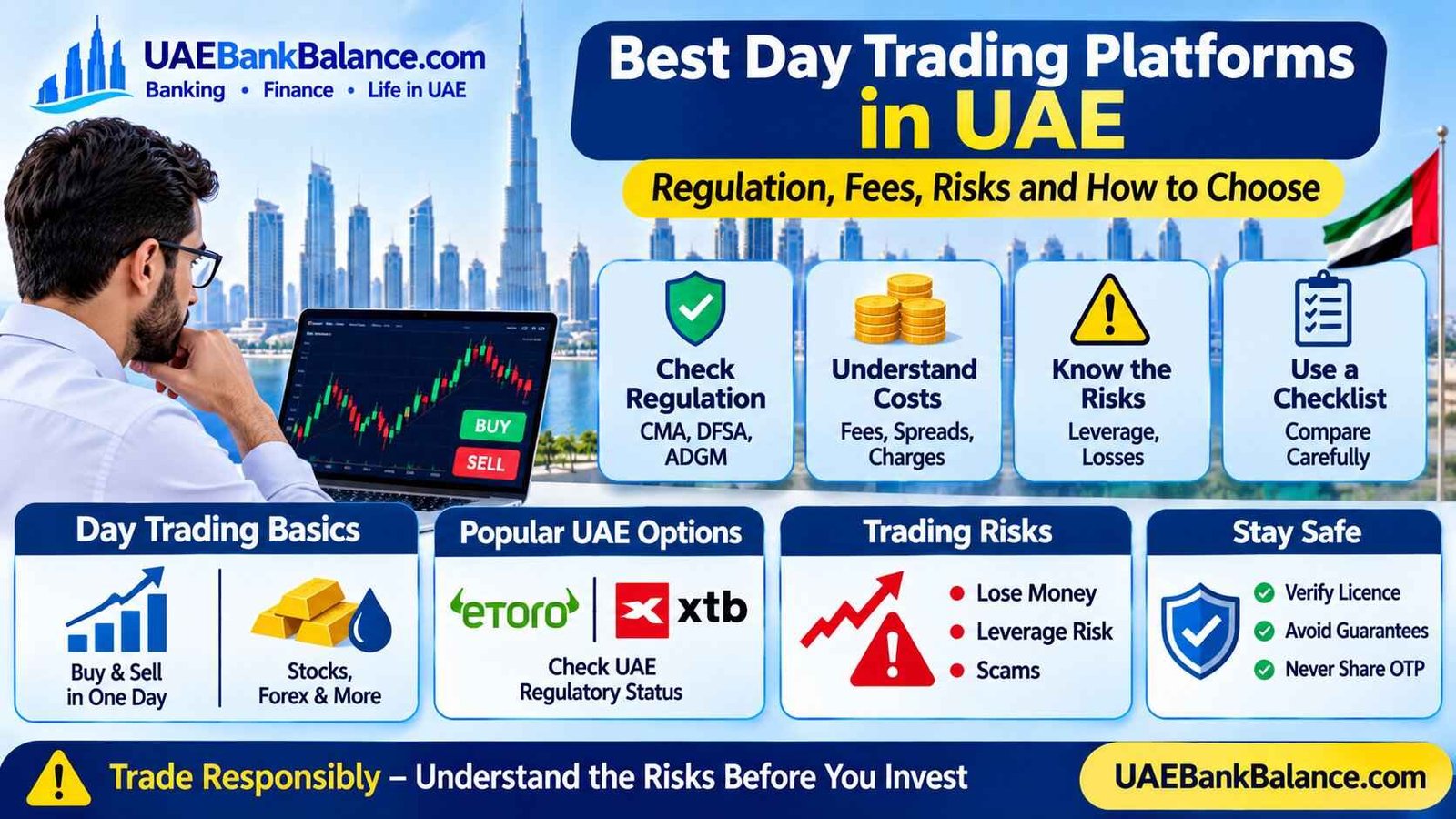
Best Day Trading Platforms in UAE 2026: Regulation, Fees, Risks and How to Choose
Last Updated on November 17, 2026 by admin
Choosing a day trading platform in the UAE is not simply about finding an app with attractive charts or a low minimum deposit. The more important question is: Who actually holds your trading account, which regulator authorises that company, and what could happen if your trades go against you?
Many platforms advertise access to international stocks, forex, commodities, indices and CFDs. However, these products do not all work in the same way. Some involve buying an actual investment, while others involve trading price movements through contracts. The risks, fees and protections can be very different.
This guide explains how to compare day trading platforms in the UAE, check their regulatory status, understand trading costs and recognise the risks before putting money into an account. It is an educational comparison, not a recommendation to start trading.
Safety Note: UAEBankBalance.com is an informational platform only. We are not a broker, investment adviser or trading service. We do not open trading accounts, hold customer funds, execute trades or guarantee profits. We do not access your banking or brokerage information. Always verify a platform’s legal entity, regulatory permissions, fees and risk disclosures through the relevant official regulator before depositing money.
What Is Day Trading?
Day trading means buying and selling financial instruments within the same trading day. Traders attempt to benefit from short-term price movements rather than holding an investment for months or years.
For example, a trader might buy shares in the morning and sell them later that afternoon if the price rises. Another trader might use a forex or CFD account to speculate on currency movements.
Day trading can involve:
- Company shares and exchange-traded funds (ETFs)
- Forex currency pairs
- Stock market indices
- Commodities such as gold and oil
- Contracts for Difference (CFDs)
- Futures and options, where available and permitted
These products are not interchangeable. Buying an actual share may give you ownership rights, while a CFD generally gives you exposure to a price movement without ownership of the underlying asset.
Before choosing a platform, understand exactly what product you are opening an account to trade.
Which Trading Platforms Should UAE Residents Research?
There is no single platform that is automatically best for every UAE resident. The right choice depends on the product you want to trade, the legal entity providing your account, its regulatory permissions, charges and the protections available to you.
The following are examples of providers with entries in UAE regulatory registers. They are research starting points, not endorsements or a ranking of the best brokers.
| Provider or UAE entity | Regulatory register to check | What readers should verify |
|---|---|---|
| eToro (ME) Ltd | ADGM FSRA | Its authorised activities, product permissions and account terms |
| XTB MENA Limited | DFSA | Its permissions for the specific investment or product being offered |
| Pepperstone Financial Services (DIFC) Limited | DFSA | The exact services authorised for this DIFC entity and which company will hold the retail account |
The official registers are more important than a platform’s advertising. For example, a company may have a UAE-regulated affiliate while a customer’s account is opened with a different overseas company. A brand name alone does not establish which regulator protects a particular account.
The DFSA register also shows that regulatory permissions can be limited to specific services and instruments. Do not assume that a firm’s authorisation for one activity means it can provide every type of trading product.
Before opening an account, ask the provider to identify the exact legal entity in your client agreement.
How to Check Whether a Trading Platform Is Regulated in the UAE
This is one of the most important checks before depositing money.
The UAE has different financial regulatory jurisdictions. The regulator you need to check depends on where the firm operates and which legal entity provides the service.
1. Capital Market Authority (CMA)
The UAE’s federal securities regulator is the Capital Market Authority, previously known as the Securities and Commodities Authority (SCA).
Use the official CMA website and its licensed-company information to check the firm’s legal name, licence status and permitted activities.
Pay attention to the licence category. A firm authorised for financial consultation or introducing clients is not necessarily authorised to execute trades or hold client assets.
2. Dubai Financial Services Authority (DFSA)
The DFSA regulates financial services conducted in or from the Dubai International Financial Centre (DIFC).
You can search its official public register.
Check the company’s exact name, reference number, authorised financial services, restrictions and whether it can deal with retail clients.
3. Abu Dhabi Global Market Financial Services Regulatory Authority (ADGM FSRA)
The FSRA regulates financial services within Abu Dhabi Global Market (ADGM).
Use the official ADGM public registers to find financial firms and verify their permissions.
Do not rely on a company’s claim that it has an Abu Dhabi office or is associated with ADGM. Check whether the actual account provider appears in the FSRA register and is authorised for the service being offered.
A practical regulatory check
Before depositing money, follow these steps:
- Find the full legal company name in the platform’s account-opening documents.
- Open the regulator’s official website yourself.
- Search for the exact legal entity, not just the trading brand.
- Check whether its status is active.
- Read the permitted activities and any restrictions.
- Match the official contact details with the details supplied by the platform.
- Confirm which legal entity will receive and hold your money.
A licence is not a guarantee that you will make money or that every product is suitable for you. It is also important to understand which regulator’s rules apply to your particular account.
Real Shares vs CFDs: Understand What You Are Trading
A common mistake among beginners is assuming that every trading app allows them to buy and own the assets shown on its screen.
That is not always true.
| Feature | Buying actual shares | Trading share CFDs |
|---|---|---|
| Ownership | You generally own the shares purchased | You do not own the underlying shares |
| Main purpose | Investing or trading the shares | Speculating on price movements |
| Leverage | Depends on the account and product | May be available |
| Main costs | Commission, exchange and other applicable charges | Spread, commission and possible overnight financing |
| Main risk | The share price can fall and cause losses | Price movements and leverage can magnify losses |
Always check the product description and contract before placing an order. A platform may offer both real shares and CFDs, but the terms can differ depending on the account and country.
Understanding Trading Fees Before Choosing a Platform
A platform advertising zero commission does not necessarily mean trading is free.
You should check the full cost of using the account.
Spread: The difference between the buying and selling prices. A wider spread can make it more expensive to enter and exit a trade.
Commission: Some providers charge a separate fee when you buy or sell certain products.
Overnight financing: CFD and leveraged positions may incur financing charges when held overnight. This can make frequent or extended trading more expensive.
Currency conversion: If your account is in AED but you trade an instrument priced in USD or another currency, conversion charges may apply.
Deposit and withdrawal fees: Check whether the platform charges for moving money into or out of your account.
Inactivity fees: Some providers charge when an account is unused for a specified period.
Do not compare platforms using only their advertised spread or commission. Review the complete fee schedule and the terms that apply to your account.
How Much Money Do You Need to Start Day Trading in the UAE?
There is no universal minimum deposit for every trading platform. The amount depends on the provider, account type, financial instrument and applicable rules.
However, the minimum deposit is not the same as the amount you can safely afford to lose.
For example, imagine a trader deposits AED 1,000 and uses 10 times leverage. The position has exposure of AED 10,000.
If the market moves 1% against the position, the loss could be approximately AED 100 before fees and other adjustments. That represents 10% of the original AED 1,000 margin.
If the market moves 5% against the position, the loss could be approximately AED 500 before costs.
This simplified example shows why leverage matters. A relatively small market movement can have a much larger effect on the money committed to a leveraged position.
Never choose a platform simply because it offers a low deposit or high leverage.
The Main Risks of Day Trading
Day trading can result in rapid losses. Understanding the risks is more important than learning how to place an order.
1. Losing Your Deposited Money
A trade can move in the opposite direction to your expectation. You may lose part or all of the funds held in your trading account, depending on the product and account protections.
Never use money needed for rent, food, school fees, loan payments or other essential expenses.
2. Leverage Can Magnify Losses
Leverage allows a trader to control a larger position with a smaller amount of money. It also magnifies the effect of adverse price movements.
A trader who does not fully understand margin requirements can lose money much faster than expected.
3. Stop-Loss Orders Are Not Always Guaranteed
A stop-loss order is intended to close a position when the market reaches a specified level. However, during fast-moving or volatile market conditions, an ordinary stop-loss may execute at a different price.
A guaranteed stop-loss, where offered, has separate conditions and may involve an additional charge.
4. Slippage Can Increase Trading Costs
Slippage happens when an order executes at a different price from the one expected.
It can occur during market volatility, price gaps or periods of limited liquidity. This means the final result may be worse than the price shown when you placed the order.
5. Frequent Trading Can Increase Costs
Opening and closing many positions can create repeated spreads, commissions and other charges.
Even if some trades are profitable, accumulated costs can reduce the overall result.
6. Emotional Decisions Can Cause Further Losses
After losing money, some traders try to recover it quickly by increasing their position size or taking additional risks.
This is often called revenge trading. It can turn one loss into a much larger financial problem.
A trading decision should not be driven by frustration, fear of missing out or pressure from social media.
Trading Scams UAE Residents Should Watch For
Not every website, social media account or person advertising trading services is genuine.
Be careful if someone:
- Promises guaranteed daily or monthly profits.
- Claims that losses are impossible.
- Contacts you unexpectedly through WhatsApp or Telegram.
- Pressures you to deposit money immediately.
- Asks you to transfer money to a personal bank account.
- Requests your OTP, banking password or remote access to your device.
- Claims to be a regulated broker but cannot provide a verifiable legal entity.
- Uses a website that copies the name or registration details of a genuine company.
- Demands extra payments to release supposed trading profits.
A real regulatory register can also be copied by scammers. Always access the register directly through the regulator’s official website rather than relying on a link sent by a salesperson.
If you believe you have been scammed, contact your bank promptly if you have transferred money or shared payment details. Keep messages, receipts, website addresses and screenshots, and report the matter to the relevant authorities.
How to Choose a Day Trading Platform: A Beginner’s Checklist
Before opening an account, take time to answer these questions:
| What to check | Why it matters |
|---|---|
| Legal company name | Identifies the company responsible for your account |
| Regulatory authorisation | Helps establish whether the company can provide the service |
| Product type | Shows whether you are buying an asset or trading a derivative |
| Trading fees | Helps calculate the actual cost of trading |
| Leverage and margin | Shows how much exposure and potential loss you may take |
| Withdrawal terms | Explains how you can access your money |
| Customer support | Helps you understand how to raise account or payment issues |
| Risk disclosure | Explains the risks of the products you intend to trade |
Do not rush through the account-opening process. Read the client agreement, product terms and risk disclosure before accepting them.
Is Day Trading Suitable for Beginners in the UAE?
Day trading is not an easy way to earn regular income. It requires an understanding of financial products, market behaviour, costs and risk management.
Beginners may be better served by learning the difference between investing and trading before considering a live trading account.
A demo account can help users understand an app’s features and practise placing orders. However, demo trading does not fully reproduce the emotions, execution conditions or financial consequences of trading with real money.
If you are not comfortable with the possibility of losing your trading capital, leveraged day trading may not be appropriate for you.
Frequently Asked Questions
Which is the best day trading platform in UAE?
There is no single platform that is best for everyone. Compare the legal entity, regulatory permissions, available products, trading costs, withdrawal terms and risk disclosures before choosing a provider.
Is day trading legal in the UAE?
Financial trading services are subject to UAE regulatory requirements. The provider must have the appropriate authorisation for the activities and products it offers in the relevant jurisdiction. Verify the exact company and its permissions through the CMA, DFSA or ADGM FSRA, as applicable.
Can I lose all my money through day trading?
Yes. Depending on the product, leverage and account protections, you can lose all the funds in your trading account. Margin trading can magnify losses, so never trade money you cannot afford to lose.
Are CFDs the same as buying shares?
No. Buying actual shares generally gives you ownership of those shares. A CFD is a derivative that allows you to speculate on price movements without owning the underlying asset.
Does a UAE regulatory licence guarantee trading profits?
No. Regulation does not guarantee profits, prevent market losses or make a financial product suitable for every person. It is important to verify the firm’s specific permissions and understand the risks.
Should beginners use leverage for day trading?
Beginners should first understand how leverage, margin calls, slippage and potential losses work. Leverage increases exposure and can magnify losses. A platform offering high leverage is not necessarily a better choice.
How can I check whether a trading broker is genuine?
Find the exact legal entity in the client agreement and search for it through the relevant regulator’s official register. Confirm its status, permissions and contact details. Be alert to cloned websites and people impersonating regulated firms.
Final Thoughts
Choosing a day trading platform in the UAE should start with regulation, transparency and risk—not promises of quick profits.
Check the company that will actually hold your account, understand whether you are buying real assets or trading CFDs, compare all charges and read the risk disclosure carefully. If a provider cannot clearly explain its legal entity, permissions, fees and withdrawal process, do not rush into depositing money.
The most useful trading decision may sometimes be deciding not to trade until you understand the risks.
Disclaimer
This article is for general educational and informational purposes only. It does not constitute financial, investment, legal, tax or trading advice, and it should not be treated as a recommendation to buy, sell or hold any financial instrument or to open an account with a particular broker.
UAEBankBalance.com is an informational platform only. We are not a licensed broker, financial adviser, investment manager or trading platform. We do not guarantee returns, trading results, account approval or the safety of any investment. Financial markets involve risk, and you may lose some or all of your invested money. Leveraged products and CFDs carry additional risks.
Regulatory status, product availability, fees and account conditions can change. Readers should verify all information directly with the relevant regulator and provider before making financial decisions. Consider seeking advice from an appropriately qualified independent professional if you are unsure whether a financial product is suitable for you.