UAE Bank KYC Emirates ID Update (2026): How to Update Your Bank Records
If your Emirates ID has recently been renewed, expired, replaced, or your personal information has changed, you may need to update your details with your UAE bank. This process is commonly called a KYC update, and it helps the bank keep your identity and customer records current.
A common problem is that a customer receives a new Emirates ID but forgets to update the bank. The old ID may continue to appear in the bank’s records, and the customer may later receive a KYC reminder or experience restrictions until the required information is updated.
In this guide, you will learn what UAE bank KYC means, why your Emirates ID needs to be updated, what documents you may need, how the update normally works, what happens if you do not complete it, and how to update your information safely.
Official Source: The Central Bank of the UAE explains that customer due diligence and KYC controls are fundamental requirements for licensed financial institutions, including maintaining and refreshing customer information.
What Is KYC in UAE Banking?
KYC means Know Your Customer. It is the process banks and other financial institutions use to identify and verify their customers and understand the nature and purpose of their financial relationship.
In the UAE, KYC is part of the wider customer due diligence and financial-crime compliance framework. CBUAE guidance requires licensed financial institutions to identify and verify customers and maintain appropriate customer information.
KYC is not something that happens only when you open a bank account. Customer information may need to be reviewed and refreshed later when documents expire, information changes, or the bank requires an updated review.
Why Do UAE Banks Ask for an Emirates ID Update?
The Emirates ID is an important identity document for UAE residents, so banks need accurate information about the document on their records.
When your Emirates ID is renewed, the new card may have a different expiry date and updated information. Your bank therefore needs to make sure its customer records contain the latest valid identification information.
The CBUAE’s current guidance says financial institutions should refresh customer information periodically or when certain defined events occur.
This is why a bank may send you an SMS, email, app notification, or other communication asking you to complete a KYC update.
When Should You Update Your Emirates ID With the Bank?
You should generally update your bank when your Emirates ID or other important customer information changes.
Common situations include:
- You received a renewed Emirates ID.
- Your previous Emirates ID expired.
- Your personal information has changed.
- Your residency information has changed.
- Your passport details have changed.
- Your residential address has changed.
- Your employment information has changed.
- The bank has specifically requested a KYC review.
Do not wait until you need an important banking service if you already know that your identification information has changed.
What Documents Are Usually Required?
The exact documents depend on your bank, account type, nationality, residency status, and the reason for the KYC update.
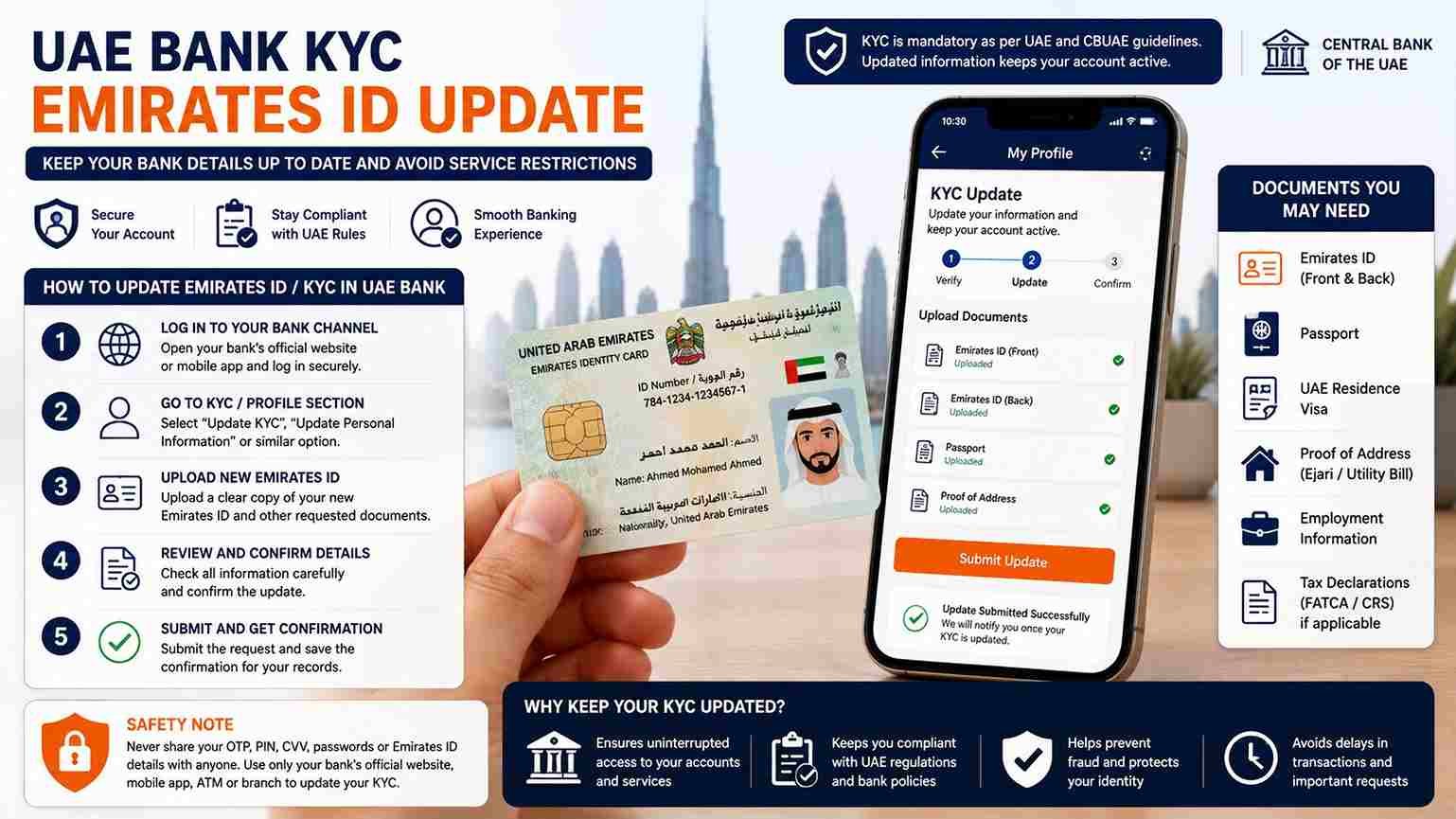
For an individual customer, the bank may request:
- Latest Emirates ID.
- Passport.
- UAE residence visa or residency information.
- Proof of residential address.
- Updated contact information.
- Employment information, where applicable.
- Tax-related declarations such as FATCA or CRS, where applicable.
For example, Emirates NBD’s KYC update service lists the latest Emirates ID, passport, visa, proof of UAE residential address, and applicable tax declarations among documents that may be requested.
Your bank may request fewer or additional documents, so follow the requirements displayed through your bank’s official channel.
How to Update Emirates ID for a UAE Bank Account
There is no single update procedure used by every bank in the UAE. Some banks provide a digital KYC service, while others may allow updates through mobile banking, online banking, ATMs, branches, or a combination of these methods.
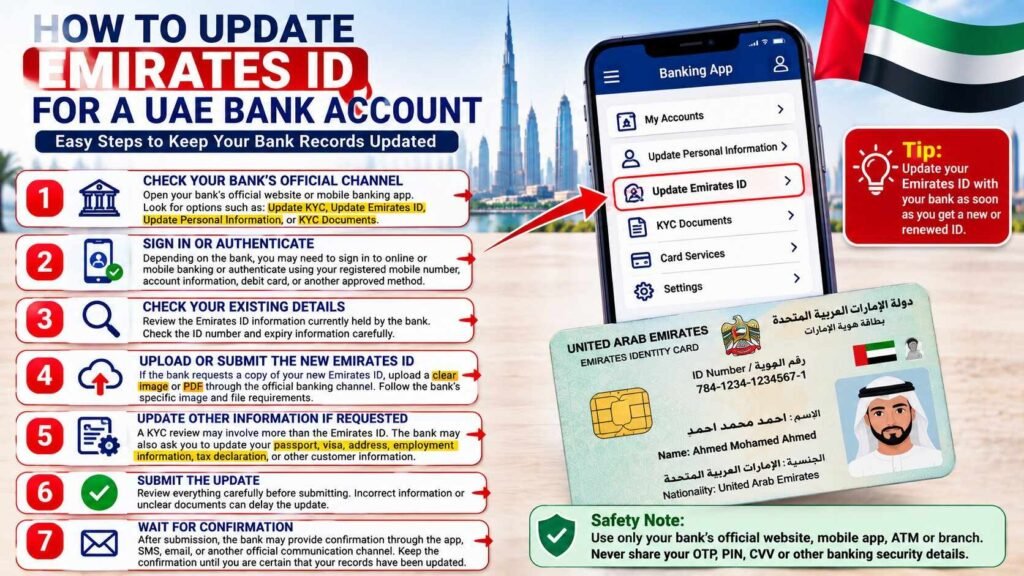
The general process is:
Step 1: Check Your Bank’s Official Channel
Open your bank’s official website or mobile banking app.
Look for options such as:
Update KYC, Update Emirates ID, Update Personal Information, or KYC Documents.
Step 2: Sign In or Authenticate
Depending on the bank, you may need to sign in to online or mobile banking or authenticate using your registered mobile number, account information, debit card, or another approved method.
Step 3: Check Your Existing Details
Review the Emirates ID information currently held by the bank.
Check the ID number and expiry information carefully.
Step 4: Upload or Submit the New Emirates ID
If the bank requests a copy of your new Emirates ID, upload a clear image or PDF through the official banking channel.
Follow the bank’s specific image and file requirements.
Step 5: Update Other Information if Requested
A KYC review may involve more than the Emirates ID.
The bank may also ask you to update your passport, visa, address, employment information, tax declaration, or other customer information.
Step 6: Submit the Update
Review everything carefully before submitting.
Incorrect information or unclear documents can delay the update.
Step 7: Wait for Confirmation
After submission, the bank may provide confirmation through the app, SMS, email, or another official communication channel.
Keep the confirmation until you are certain that your records have been updated.
Can I Update Emirates ID KYC Online?
Yes, some UAE banks provide online KYC update services, but the exact process varies by bank.
For example, ADCB currently provides an online KYC document update service that allows customers to submit identification documents without visiting a branch. ADCB says customers may need their CID number or credit/debit card number, passport, Emirates ID, and registered mobile number.
ADCB also provides KYC document updating through its mobile banking app, where customers can update their passport and Emirates ID and manage certain FATCA and CRS information.
This means you should not assume that every bank requires a branch visit.
Emirates NBD Emirates ID KYC Update
Emirates NBD provides several options for customers to update their Emirates ID information.
Its official support information states that customers can update their Emirates ID through an ATM, mobile app, or website.
Emirates NBD also provides a digital KYC remediation portal. Customers can authenticate themselves, view the information that needs updating, and submit the required details and documents electronically.
The bank’s online banking service also lists updating Emirates ID, passport details, address, residency status, visa, employment details, and other personal information among available services.
ADCB Emirates ID KYC Update
ADCB provides a dedicated KYC Documents Update service.
Customers can upload their identification documents online, including an Emirates ID and passport. ADCB states that uploaded documents should be clear, show all four borders, be correctly aligned, and meet its file-size requirements.
If you use ADCB, check the bank’s current KYC page rather than relying on instructions from an unofficial website because the digital process and document requirements can change.
Do I Need to Visit a Bank Branch?
Not necessarily.
Whether you need to visit a branch depends on your bank and the type of update being requested.
If your bank offers a digital KYC facility and your update can be completed online, you may not need a branch visit. Some banks also provide ATM or mobile banking options.
However, the bank may ask you to visit a branch or contact a relationship manager if:
- Online verification fails.
- Your information does not match the bank’s records.
- Additional documents are required.
- Your account requires enhanced due diligence.
- Your account is dormant or restricted.
- The bank specifically requests physical verification.
For example, Emirates NBD states that customers with dormant accounts may need to submit KYC documents and contact their branch or Relationship Manager to initiate reactivation.
What Happens If You Do Not Update Your KYC?
Ignoring a KYC request is not recommended.
Banks need to maintain valid and up-to-date customer information. If required information remains incomplete or outdated, the bank may restrict certain services or access according to its applicable requirements and terms.
Emirates NBD specifically states that failure to provide complete KYC information can affect access to banking services and accounts.
The exact consequences vary by bank and individual circumstances.
If you receive a genuine KYC request, complete it through the bank’s official channel rather than ignoring it.
Why Is My KYC Update Not Accepted?
There are several reasons why a bank may reject or delay an Emirates ID update.
One common problem is a poor-quality document image.
For example, the Emirates ID may be:
- Blurry.
- Cropped incorrectly.
- Missing one or more edges.
- Rotated.
- Too large for the permitted file size.
- Difficult to read.
ADCB specifically instructs customers submitting KYC documents to ensure that the document details are clearly visible, all four borders are shown, the document is front-facing, and the file meets the stated size requirement.
Other reasons can include information mismatches, expired documents, incomplete forms, or additional verification requirements.
What If My Emirates ID Is Renewed but My Bank Still Shows the Old One?
If you have already received your renewed Emirates ID but your bank still displays the old details, check whether the bank has a dedicated Emirates ID or KYC update option.
Do not assume that the bank automatically receives every update immediately.
For example, Emirates NBD provides a specific facility for customers to view the Emirates ID recorded on its systems and update it through its supported channels.
If the digital update does not work, contact your bank through its official customer service channel or visit a branch.
Does KYC Include More Than Emirates ID?
Yes.
An Emirates ID update is only one part of KYC.
Depending on your circumstances, the bank may need information about your identity, address, employment, residency, source of funds or wealth, tax status, and other aspects of your banking relationship.
The CBUAE’s KYC guidance states that customer due diligence can include understanding the customer’s identity, business or occupation, source of income or wealth, source of funds, expected activity, and ongoing relationship.
Therefore, if your bank asks for several documents during a KYC review, it does not necessarily mean there is a problem with your account.
How Often Do Banks Require KYC Updates?
There is no single fixed interval that applies identically to every UAE bank customer.
The frequency can depend on the bank’s risk-based KYC procedures and your circumstances.
The CBUAE says licensed financial institutions should refresh customer information periodically and when certain defined triggers occur.
Your bank may therefore contact you when it needs updated information rather than asking every customer to complete exactly the same KYC process at the same time.
Can I Update KYC After My Emirates ID Expires?
If your Emirates ID has expired and you have already received a renewed card, you should provide the bank with the latest valid identification information through its official update process.
If you have not yet received your renewed ID, contact your bank to determine what alternative documents or information it can accept in your specific situation.
Do not upload an unofficial document or altered copy simply to complete the process.
What Should You Do If Your Bank Sends a KYC SMS?
First, do not immediately click the link.
Instead, open your bank’s official website or mobile app independently and check whether a KYC update is required.
This is important because scammers frequently use urgent messages about account restrictions or KYC updates to persuade customers to reveal personal information.
If you are unsure whether a message is genuine, contact the bank through the telephone number or support option published on its official website.
Safety Note
Never share your OTP, online banking password, card PIN, CVV, SecurePass code, or other banking security credentials with someone who claims they can complete your KYC update. Use your bank’s official website, official mobile app, ATM, or branch as instructed by the bank, and do not upload your Emirates ID to an unknown website or send it to an unverified WhatsApp number.
ADCB’s own fraud-awareness guidance recommends accessing banking services directly through the bank’s official website or mobile app and warns customers not to share Emirates ID details, account information, passwords, or OTPs with others.
Frequently Asked Questions
What is UAE bank KYC?
KYC means Know Your Customer. It is the process banks use to identify and verify customers and maintain appropriate customer information as part of their regulatory and financial-crime compliance responsibilities.
How do I update my Emirates ID with my bank?
Use your bank’s official mobile app, online banking service, dedicated KYC portal, ATM, or branch, depending on the options provided by your bank. You will generally need your latest Emirates ID and may need additional documents.
Can I update Emirates ID online?
Yes, some UAE banks provide online KYC facilities. ADCB, for example, allows eligible customers to upload Emirates ID and passport documents through its KYC update service.
What happens if I do not complete a KYC update?
Depending on the circumstances and bank requirements, incomplete KYC information can result in restrictions on banking services. Emirates NBD states that failure to provide complete information can affect access to accounts and services.
Does KYC only mean Emirates ID?
No. KYC can involve several types of customer information and documents, including identity, address, residency, employment, tax information, and information relevant to the customer’s financial relationship.
Do all UAE banks use the same KYC update process?
No. The regulatory requirements provide the framework, but each bank can have its own procedures, digital channels, document requirements, and verification process.
Conclusion
Updating your Emirates ID with your UAE bank is an important part of keeping your KYC information accurate. If you have received a renewed Emirates ID, changed important personal information, or received a KYC update request from your bank, check the bank’s official digital or branch channels and complete the required update.
The process can be fully digital with some banks. ADCB currently provides online KYC document submission, while Emirates NBD supports Emirates ID updates through its ATM, mobile app, and website.
The safest approach is simple: use only your bank’s official channels, provide clear and accurate documents, and never share your banking security credentials with anyone.
Official UAE KYC Source
Central Bank of the UAE – Customer Due Diligence and KYC:
https://rulebook.centralbank.ae/en/rulebook/31-general-principles
Official Bank KYC Update Pages
ADCB – KYC Documents Update:
https://www.adcb.com/en/ways-to-bank/kyc-documents-update/
Emirates NBD – Update Your Emirates ID:
https://www.emiratesnbd.com/en/help-and-support/update-your-emirates-id