UAE Bank Borrower Support: What to Do If You Cannot Manage Your Loan Payment
A loan payment can feel completely manageable when you first take the loan. Then something changes. Your salary may be delayed or reduced, your expenses may suddenly increase, or you may simply have too many monthly commitments at the same time.
When that happens, many borrowers make the same mistake: they stop answering the bank because they are worried about what will happen next.
That usually does not make the problem easier.
If you are struggling with a loan payment in the UAE, the better approach is to contact your bank and explain the situation before the problem becomes more serious. Depending on your circumstances, there may be repayment-support options that you can discuss with the bank.
This guide explains UAE bank borrower support in simple language, including what help you can ask about, how to approach your bank, what to do if you have already missed a payment, and what you can do if your complaint is not resolved.
Safety Note: UAEBankBalance.com is an informational platform only. We do not provide loan restructuring, process borrower-support requests, access your bank account, or have access to your personal financial information. Never pay an unknown person or website promising guaranteed loan cancellation or guaranteed restructuring. Do not share your Emirates ID, bank statements, passwords, card details, or OTP with anyone claiming they can arrange loan support for you. For official information, check the Central Bank of the UAE and Sanadak.
What Is UAE Bank Borrower Support?
UAE bank borrower support means the assistance and communication available to customers who are having difficulty meeting their loan or credit payments.
The Central Bank of the UAE’s responsible conduct requirements say financial institutions should provide assistance when initial payment irregularities are identified and encourage customers to discuss their financial difficulties with them.
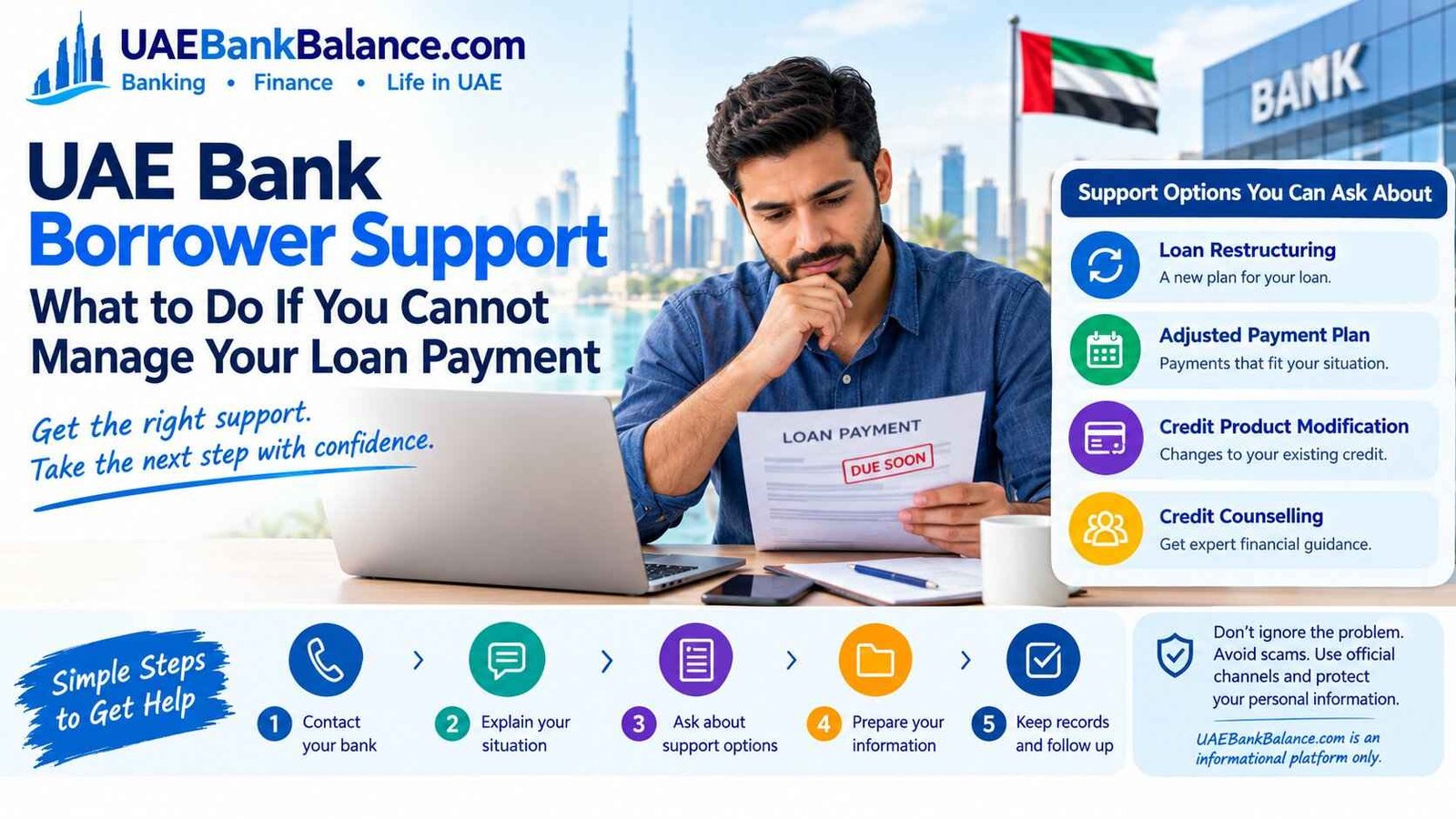
The framework also includes support mechanisms such as financial restructuring, credit-product modification, adjusted payment plans, and impartial credit counselling for customers experiencing debt-servicing difficulties.
This is important because borrower support does not simply mean asking the bank to cancel a payment.
It is about opening a conversation with the bank and finding out what options may be available for your particular situation.
The bank will still assess your circumstances. Support is not automatically approved for every borrower.
When Should You Contact Your Bank?
You do not have to wait until several payments have been missed before contacting your bank.
If you already know that your next payment may be difficult, contact the bank as early as possible.
For example, you may have:
- A sudden reduction in income
- Increased household expenses
- Unexpected medical or family expenses
- Employment-related financial difficulties
- Several loans or credit commitments becoming difficult to manage
- An existing overdue payment
The CBUAE framework specifically expects financial institutions to assist when initial payment irregularities are observed and encourage customers to engage with them about financial difficulties.
So, if you are already worried about the next payment, waiting silently is usually not the most useful approach.
What Support Can You Ask Your Bank About?
When you contact your bank, explain that you are experiencing financial difficulty and ask what borrower-support options are available.
Depending on your circumstances, the discussion may include restructuring, modifying a credit product, adjusting the payment arrangement, or credit counselling.
| Support option | What it may involve |
|---|---|
| Loan restructuring | Reviewing the existing loan arrangement and considering a revised structure |
| Adjusted payment plan | Reviewing how payments are scheduled based on your circumstances |
| Credit-product modification | Considering changes to the existing credit arrangement where applicable |
| Credit counselling | Discussing debt-servicing difficulties and possible repayment arrangements |
The important point is that these are possible support mechanisms, not guaranteed results.
Your bank will decide what options are available based on your circumstances and its applicable requirements.
How to Ask Your Bank for Borrower Support
Step 1: Contact the Bank Through an Official Channel
Start with the bank that provided your loan.
Use its official mobile app, website, branch, or customer-service channel.
Avoid using an unknown “loan relief agent” who contacts you through WhatsApp, Facebook, Instagram, Telegram, or another unofficial channel.
Tell the bank that you are experiencing financial difficulty and want to discuss your repayment options.
Step 2: Explain What Changed
You do not need to write a long explanation.
Simply explain what caused your financial situation to change.
For example:
“My monthly financial commitments have increased and I am finding it difficult to maintain the current loan payment. I would like to know what repayment-support options are available.”
If your income has changed, explain that. If your expenses have increased, explain that as well.
Being clear helps the bank understand the reason behind the request.
Step 3: Ask Specifically About Available Options
Do not just ask, “Can you help me?”
Ask specific questions.
You can ask:
“Are there any repayment-support options available for my loan?”
“Can my loan be reviewed for restructuring?”
“Is there an adjusted payment plan available?”
“Can I speak with someone about credit counselling or debt-servicing difficulties?”
This makes the conversation much clearer.
Step 4: Prepare Your Financial Information
The bank may ask for documents or information before reviewing your request.
The exact requirements can vary, so ask the bank what documents are required for your particular case.
It is also useful to understand your own monthly situation before contacting the bank.
Write down:
- Monthly income
- Current loan payment
- Other loan or credit payments
- Rent or housing costs
- Essential household expenses
- Other major financial commitments
You do not need a complicated spreadsheet. A simple monthly picture is enough to help you understand what you can realistically afford.
Step 5: Ask for Important Terms in Writing
If the bank offers a revised repayment arrangement, do not rely only on a verbal explanation.
Ask for the details in writing.
Check the new monthly payment, repayment period, applicable charges, and other important terms before agreeing.
The CBUAE framework includes written disclosure requirements in applicable cases where a revised payment arrangement is agreed.
What If You Already Missed a Loan Payment?
If you have already missed a payment, do not assume the situation is hopeless.
Contact the bank as soon as possible and explain why the payment was missed.
Ask what options are available to address the arrears and how you can bring the account back into a manageable repayment arrangement.
The CBUAE responsible conduct framework requires financial institutions to communicate appropriately with customers in arrears and advise them about possible consequences of continued non-payment.
Depending on the circumstances, continued non-payment can lead to consequences such as credit-information reporting, collection activity, or legal proceedings.
The exact consequences depend on the loan agreement, applicable rules, and your particular situation.
That is why ignoring the bank is not a good way to handle an overdue payment.
Can the Bank Reduce Your Monthly Loan Payment?
You can ask the bank whether an adjusted repayment arrangement or restructuring option is available.
However, you should not assume that the bank must reduce your monthly payment.
If a revised arrangement is offered, ask how it changes the overall loan.
A lower monthly payment can sometimes mean that the repayment period changes or that the overall financial cost is different.
Before accepting anything, ask the bank:
- What will my new monthly payment be?
- How long will I continue making payments?
- What will the total repayment amount be?
- Are there any fees or charges?
- How will existing arrears be treated?
- How will the arrangement be reported to the credit information agency?
Getting these answers first can prevent surprises later.
Does Loan Restructuring Affect Your Credit Record?
This is an important question to ask before agreeing to a revised arrangement.
Borrowers should not assume that restructuring or arrears will have no effect on their credit information.
The CBUAE framework states that, where a revised payment arrangement is agreed, customers should be informed that information relating to arrears may need to be shared with the Credit Information Agency.
Your bank can explain how your particular arrangement and any existing arrears will be reported.
What If the Bank Rejects Your Borrower-Support Request?
A borrower-support request is not automatically approved.
If the bank does not agree to the option you requested, ask why and whether another solution is available.
For example, you could ask:
“I understand that this option is not available. Are there any other repayment-support options that I can apply for?”
If you believe your request or complaint has not been handled properly, use the bank’s formal complaints process.
Keep the complaint reference number and copies of your communication.
This becomes especially important if you later need to escalate the matter.
How to Make a UAE Bank Loan Complaint
Your first formal step should normally be to complain directly to the bank or financial institution.
Do not rely only on a phone call.
Use the bank’s official complaint process and explain:
- What happened
- When you contacted the bank
- What support you requested
- What response you received
- Why you believe the issue remains unresolved
- What resolution you are asking for
Keep copies of your complaint and the bank’s response.
When Can You Take a Complaint to Sanadak?
If you have already complained to the financial institution and the issue remains unresolved, Sanadak may be an option for eligible complaints.
Sanadak handles eligible complaints involving licensed financial institutions. Its complaint areas include personal loans, car loans, mortgages, credit cards, accounts, and payment services.
According to Sanadak’s current eligibility information, you generally need to complain to the financial institution first. If 15 calendar days have passed without a written response, or you received a response but are not satisfied, you may be able to submit an eligible complaint to Sanadak, subject to its other requirements.
Not every dispute automatically qualifies, so check Sanadak’s current eligibility requirements before submitting.
How to Submit a Sanadak Complaint
Step 1: Complain to the Bank First
Make an official complaint through your bank’s complaint channel.
Keep the complaint reference number.
Step 2: Wait for the Required Response Period
Sanadak’s current guidance refers to the applicable 15-calendar-day period where there is no written response, while a customer who receives an unsatisfactory response may also be eligible to proceed, subject to the other requirements.
Step 3: Collect Your Documents
Prepare relevant documents such as:
- Bank complaint reference
- Bank response
- Loan documents
- Relevant statements
- Emails or letters
- Other documents supporting your complaint
Only provide documents through official Sanadak or financial-institution channels.
Step 4: Submit the Complaint
Sanadak provides different complaint submission methods, including online, app, phone, and in-person options. You will need to provide the details of your complaint and supporting documents where required.
Step 5: Follow the Resolution Process
Sanadak may request additional information during its review.
Its published process explains that eligible complaints are reviewed and the decision is communicated in writing.
What Documents Should You Prepare?
There is no single document list that applies to every borrower-support request.
Your bank may ask for different information depending on your loan and circumstances.
However, having the following information ready can make the discussion easier:
| Information | Why it may be useful |
|---|---|
| Current income | Helps explain your present financial position |
| Current loan payment | Shows the repayment amount causing difficulty |
| Other financial commitments | Gives a clearer picture of your monthly obligations |
| Reason for financial difficulty | Helps explain what changed |
| Bank correspondence | Useful if payments are already overdue |
| Previous complaint reference | Important if the issue is already under formal complaint |
Only submit sensitive documents through official channels.
What You Should Avoid When You Cannot Pay Your Loan
Do Not Ignore the Bank
If you are having difficulty paying, silence does not solve the underlying loan obligation.
Contact the bank and explain the situation.
Do Not Believe Guaranteed Debt-Relief Promises
Be careful with websites or individuals promising:
“Guaranteed loan cancellation.”
“Guaranteed restructuring.”
“We can remove your loan from your credit record.”
“Pay us and we will stop the bank from taking action.”
These claims should be treated with extreme caution.
Do Not Share Your OTP
A legitimate bank representative should not require you to hand over an OTP through WhatsApp or another unofficial channel.
Never share your banking password, card PIN, or OTP with another person.
Do Not Automatically Take Another Loan
Taking another loan to cover an existing payment may increase your overall financial commitments.
Before borrowing more money, understand the total cost and whether it actually addresses the underlying problem.
A Simple UAE Borrower Support Action Plan
If you are currently struggling with a loan payment, you can start with these steps:
First: Contact your bank through its official channel.
Second: Explain what has changed financially.
Third: Ask about restructuring, adjusted payment plans, credit-product modification, or credit counselling.
Fourth: Prepare your income, expenses, loan information, and supporting documents.
Fifth: Ask for any revised arrangement and important terms in writing.
Sixth: Keep all communication and complaint references.
Seventh: If you make a formal complaint and the issue is not resolved, check whether you meet Sanadak’s eligibility requirements.
People Also Ask About UAE Bank Borrower Support
What is borrower support in the UAE?
Borrower support refers to assistance available to customers experiencing difficulty with loan or credit payments. Depending on the situation, this may include restructuring, adjusted payment arrangements, credit-product modification, or credit counselling.
Can I ask my bank to restructure my loan in the UAE?
Yes. You can contact your bank and ask whether restructuring or another repayment-support option is available. Approval is not automatic and depends on your circumstances and the bank’s applicable requirements.
What should I do if I cannot pay my UAE loan this month?
Contact your bank as soon as possible. Explain your financial difficulty and ask what repayment-support options are available. Do not simply stop responding to the bank.
Can Sanadak help with a UAE loan complaint?
Sanadak handles eligible complaints involving licensed financial institutions, including certain complaints relating to personal loans, car loans, mortgages, credit cards, accounts, and payment services. You generally need to complain to the financial institution first.
Does loan restructuring affect your credit record in the UAE?
It can involve credit-information reporting, particularly where arrears are involved. Ask your bank how your particular repayment arrangement and any arrears will be reported before accepting a revised arrangement.
Does UAE bank borrower support guarantee a lower payment?
No. Borrower support does not mean every borrower will receive a lower payment or approved restructuring. The bank assesses the individual situation and determines what options are available.
Final Thoughts
If your UAE loan has become difficult to manage, the first step is not to panic and it is not to disappear from the bank’s calls.
Start a conversation.
Explain what has changed, ask what support options are available, and make sure you understand the terms of any revised repayment arrangement before accepting it.
The CBUAE framework provides for financial institutions to have support mechanisms for customers experiencing debt-servicing difficulties, including possible restructuring, credit-product modification, adjusted payment plans, and credit counselling.
And if you have already complained to your bank but the eligible issue remains unresolved, Sanadak provides a separate complaint-resolution route subject to its requirements.
The main thing is simple: deal with the problem early, communicate through official channels, keep your records, and do not trust anyone promising guaranteed debt relief.