UAE Remittance App Funds Vanish: What to Do If Money Is Deducted but Not Received
You send money through a remittance app in the UAE, see the amount deducted from your bank account, and then the recipient says, “I haven’t received anything.” The app may show pending, processing, completed, failed, or sometimes give very little explanation. That is when it feels like the money has simply disappeared.
Usually, “funds vanished” does not automatically mean the money is lost. A transfer can be waiting with the remittance provider, moving through a correspondent bank, rejected by the receiving bank, held for additional checks, or already returned but not yet reflected in your available balance. The important thing is to find out exactly where the transaction stopped instead of sending the money again.
UAE rules also require licensed remittance providers to keep customer remittance funds in designated accounts used for settling those remittances, and licensed institutions have specific obligations when funds are returned.
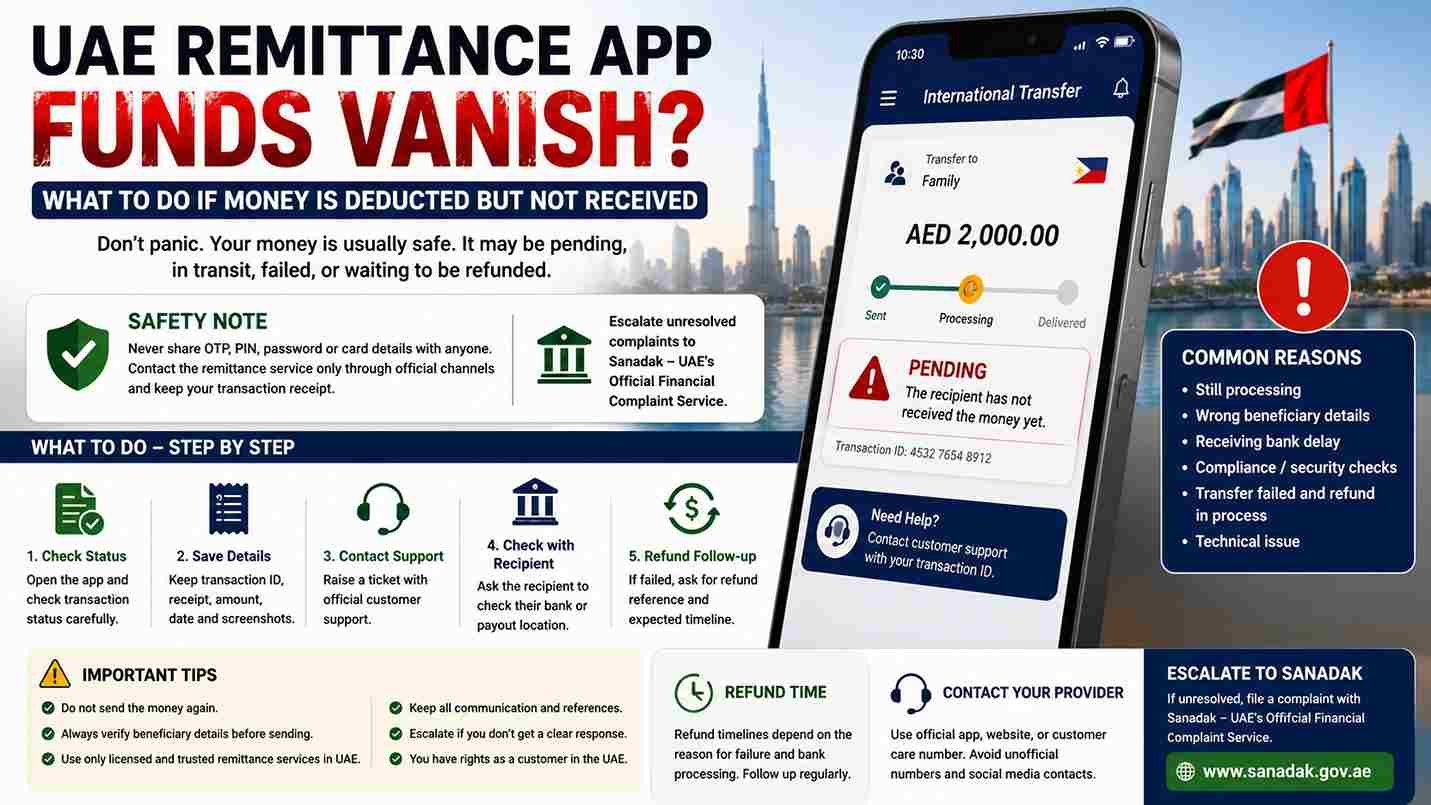
Safety Note: If a remittance app shows money deducted but the transfer has not arrived, do not give anyone your OTP, PIN, password or full card details to “release” the funds. First contact the remittance provider through its official app or website and keep the transaction receipt. If the provider is a UAE-licensed financial institution and does not resolve the problem, you can escalate through the official Sanadak complaint process.
Official complaint route: Sanadak – UAE Financial Complaint Service
What Does “Remittance App Funds Vanish” Actually Mean?
When people search for UAE remittance app funds vanish, they usually mean one of these situations:
- Money was deducted from their UAE bank account.
- The remittance app shows the transfer as pending.
- The recipient has not received the money.
- The app says the transfer failed, but the money has not returned.
- The transaction shows completed, but the beneficiary says nothing arrived.
- The app balance or wallet balance suddenly appears lower.
- A refund was promised but is not visible yet.
- Customer support is not giving a clear answer.
These situations are different, so the solution depends on the transaction status.
The first thing to establish is whether the money actually left the remittance provider or is still somewhere in the transfer process.
Did the Money Really Disappear?
Not necessarily.
There is an important difference between:
Money deducted from your bank account
and
Money successfully received by the beneficiary.
For example, suppose you send AED 1,000 to a family member overseas.
Your UAE bank may immediately show:
AED 1,000 debited
But the remittance provider may still show:
Processing
That means the bank debit has happened, but the international payment may not yet have completed.
This is why checking only your bank balance can give the impression that the money has vanished.
Why Can UAE Remittance App Funds Go Missing?
There are several possible explanations.
1. The Transfer Is Still Processing
International remittances can pass through more than one financial institution before reaching the beneficiary.
The transaction may therefore remain pending while the provider or banking network processes it.
Do not automatically create another transfer simply because the recipient has not received the first one.
You could accidentally send the amount twice.
2. The Receiving Bank Has Not Credited the Money
The remittance provider may have successfully sent the transaction, but the beneficiary’s bank may still be processing it.
This can happen because of:
- Bank processing times
- Weekends or holidays
- Beneficiary-bank checks
- Incorrect or incomplete information
- Local banking requirements
- Additional compliance checks
Ask the recipient to check with their bank using the transfer reference if the remittance provider confirms that the payment has been sent.
3. Incorrect Beneficiary Details
A wrong account number, IBAN, name or other beneficiary information can cause a transfer to be delayed or rejected.
For regulated remittance services, UAE consumer-protection rules require licensed financial institutions to validate payment instructions, including IBAN and BIC information, before completing the transfer.
Still, you should always check the information you entered before submitting a transaction.
4. The Transfer Was Returned
Sometimes the beneficiary bank or another institution in the payment chain cannot credit the recipient.
The money may then be returned.
This can create a confusing situation:
Your bank account: Money deducted
Remittance app: Failed/processing
Recipient: Nothing received
Your account later: Refund appears
The return does not necessarily happen immediately.
UAE consumer-protection standards state that when funds are returned by a correspondent bank or financial institution, the licensed financial institution must advise the consumer within two complete business days and credit the returned funds once received. There is an exception where financial-crime investigations are required.
5. Additional Compliance Checks
A transfer can sometimes require additional review.
This is particularly relevant to international payments, where banks and financial institutions have obligations relating to customer due diligence and financial-crime controls.
A delayed transfer does not by itself prove that something is wrong with your account.
If the provider tells you that the transfer is under review, ask what information or documentation is required and use only the provider’s official channel.
6. A Technical Problem
Sometimes the app and payment system do not update at exactly the same time.
For example, your bank may show the debit before the remittance app updates the transaction status.
Likewise, the beneficiary may receive the money while the app still displays an older status for a short period.
Take screenshots and keep the transaction reference rather than immediately attempting another payment.
What to Do If Your Money Was Deducted but the Recipient Did Not Receive It
Follow these steps in order.
Step 1: Do Not Send the Money Again
This is probably the most important step.
If the first transfer is still processing, sending another transaction could result in two successful transfers.
Wait until you know what happened to the original transaction.
Step 2: Open the Remittance App
Go to your transaction history.
Find the specific transfer and check its status.
Look for words such as:
- Pending
- Processing
- Completed
- Failed
- Cancelled
- Refunded
- Rejected
Take a screenshot showing the status.
Step 3: Find the Transaction Reference Number
Your transaction reference is extremely important when speaking to customer support.
Also keep:
- Date and time
- Amount sent
- Currency
- Recipient name
- Destination country
- Beneficiary bank
- Exchange rate, if shown
- Transfer fee
- Bank-debit confirmation
A proper remittance receipt should provide important transaction information, including the amount, currency, fees and complaint information.
Step 4: Check Your Bank Account
Look at the transaction in your UAE bank account.
Confirm whether the amount is:
- Fully debited
- Temporarily held
- Reversed
- Refunded
Do not rely only on the available balance.
Open the actual transaction details if your banking app provides them.
Step 5: Ask the Recipient to Check Properly
Ask the recipient to check their bank account or cash-pickup status.
If it is a bank transfer, ask them to check recent transactions rather than relying only on an SMS notification.
If the money is being collected in cash, check whether the transfer has reached the payout location.
Step 6: Contact the Remittance Provider
Use the provider’s official app, website, branch or customer-care channel.
Give them the transaction reference and explain:
The amount was deducted from my UAE bank account, but the beneficiary has not received the funds.
Ask specifically:
“Has the money been paid to the beneficiary bank, is it still processing, or has it been returned?”
That question is more useful than simply saying, “My money disappeared.”
What Information Should You Ask Customer Support For?
When speaking to support, ask for a clear answer to these questions:
- What is the current transaction status?
- Has the money left the remittance provider?
- Has it reached the correspondent bank?
- Has it reached the beneficiary bank?
- Was the transaction rejected?
- Has a refund been initiated?
- If refunded, when was it processed?
- What is the refund reference number?
- Is any additional information required from me?
- When should I expect the next update?
Write down the support ticket or complaint reference.
Do not rely on a phone conversation alone.
What If the App Says “Completed” but the Recipient Has No Money?
This situation needs extra attention.
A completed status in the remittance app does not necessarily mean that the beneficiary has already seen the funds in their account at that exact moment.
Contact the remittance provider and ask for the transaction’s payment confirmation or transfer reference.
Give that information to the recipient so their bank can investigate the incoming payment.
If the beneficiary bank confirms that nothing was received, return to the remittance provider with that information.
What If the Transfer Says “Failed” but My Money Is Still Missing?
Don’t assume the money has been permanently lost.
A failed transfer can require a reversal or refund process.
Ask the provider:
“Has the refund been initiated, and what is the expected refund date?”
Keep the answer and reference number.
UAE consumer-protection rules specifically address returned remittance funds and require regulated institutions to deal with returned funds within defined timeframes, subject to exceptions such as financial-crime investigations.
How Long Should You Wait for a Refund?
There is no single refund time that applies to every remittance app and every transaction.
It depends on where the transfer stopped and which institutions are involved.
However, UAE consumer-protection standards contain specific requirements for regulated financial institutions when funds are returned by a correspondent bank or financial institution. The institution must advise the consumer within two complete business days of the return and credit the returned funds once received, subject to the stated financial-crime-investigation exception.
So there are two different dates to understand:
The date you requested the refund
and
the date the financial institution actually received the returned funds.
Those are not necessarily the same.
What If the Remittance App Has No Useful Update?
If customer support keeps telling you to wait without explaining what happened, make a formal complaint.
Do not just keep opening ordinary chat tickets.
Ask the provider to register an official complaint and give you a complaint/reference number.
UAE rules require licensed financial institutions to maintain accessible complaint-management processes, and complaint handling is required to be available without charge.
How to Check Whether a UAE Remittance Provider Is Licensed
Before using a financial or remittance service, check whether the institution is regulated appropriately.
The Central Bank of the UAE maintains a register of licensed financial institutions. Its exchange-business framework also specifically covers remittances through digital channels.
This matters because an app appearing in a search result or mobile-app store is not the same thing as confirming that the underlying financial service is licensed in the UAE.
For a UAE customer, checking the provider’s regulatory status is a sensible first step.
What Protection Exists for Remittance Customers in the UAE?
There are important regulatory protections around licensed remittance services.
The UAE’s Central Bank framework requires licensed remittance businesses to place customer remittance funds into designated remittance intermediate accounts and use those funds for settling customer remittances with foreign correspondents.
Licensed institutions also have transparency obligations around remittance receipts, including transaction amounts, currencies, fees and complaint information.
This does not mean every transfer will arrive instantly.
It does mean there are formal rules governing licensed providers and customer complaints.
What If Customer Support Does Not Solve the Problem?
If the provider is a UAE-licensed financial institution and your complaint remains unresolved, you have an escalation route.
This is where Sanadak becomes important.
Sanadak is the UAE’s independent financial and insurance ombudsman unit for eligible complaints involving licensed financial institutions and insurance companies.
Step 1: Complain to the Remittance Provider First
You must first raise an official complaint with the relevant licensed financial institution.
Keep the complaint reference number.
Step 2: Wait for the Required Period
Sanadak’s current eligibility guidance says you can generally proceed when 15 calendar days have passed after submitting the complaint and you either received no written response or are dissatisfied with the response.
Step 3: Submit the Complaint to Sanadak
You can use Sanadak’s official complaint process and provide supporting documents.
These may include:
- Transaction receipt
- Bank statement
- Screenshots
- Complaint reference
- Emails or messages from the provider
- Beneficiary information
- Any refund information
Sanadak explains that supporting evidence should accompany the complaint.
What If You Think It Is a Scam?
This is different from an ordinary delayed remittance.
Be particularly careful if:
- Someone contacted you unexpectedly about the transfer.
- You were asked to pay an extra “release fee” to a personal account.
- Someone asks for your OTP.
- Someone asks for your banking password.
- The app suddenly asks you to install another application.
- Customer support is only available through an unofficial WhatsApp number.
- You cannot identify the company behind the app.
- The company has no clear UAE regulatory information.
- Someone asks you to send more money before your original funds can supposedly be released.
Do not send additional money simply because someone says it is needed to unlock your existing transfer.
Use the official contact information of the remittance provider instead.
A Simple Example
Imagine you send AED 2,000 from a UAE remittance app to your family’s bank account overseas.
Your UAE bank shows:
AED 2,000 deducted
The app shows:
Processing
Your family says:
Nothing received
At this point, the money has not necessarily vanished.
You should:
- Save the transaction receipt.
- Find the transaction reference.
- Check the app status.
- Confirm the recipient’s bank details.
- Contact the remittance provider.
- Ask whether the transfer is processing, paid or returned.
- Ask for a complaint/reference number if there is a problem.
- Do not send another AED 2,000 until the first transaction is resolved.
This is much safer than making a second transfer and trying to sort out both transactions later.
Keep These Documents Before Contacting Support
If you are dealing with a missing remittance, prepare everything in one place.
| Information | Why it matters |
|---|---|
| Transaction reference | Lets support locate the transfer |
| Bank debit record | Shows that money left your account |
| Remittance receipt | Shows amount, fees and beneficiary information |
| App screenshot | Records the transaction status |
| Beneficiary details | Helps identify the destination |
| Support ticket | Proves you contacted the provider |
| Complaint reference | Needed for escalation |
| Refund reference | Helps track returned money |
Having this information ready can make the investigation much faster.
Can a Remittance Be Cancelled?
Sometimes, but it depends on the transaction’s status and the provider’s terms.
If the transfer has not yet been paid or settled, cancellation may be possible.
If the money has already been paid to the beneficiary, cancellation may not be possible.
Contact the provider immediately if you entered the wrong beneficiary details.
Do not wait several days hoping the problem will correct itself.
What Happens to Unclaimed Remittance Money?
UAE rules also address certain unclaimed funds connected with money-transfer transactions.
For example, an outward money transfer to a bank account can become classified as unclaimed funds if it is not returned to the customer within the specified period after cancellation or after the beneficiary bank returns it because it could not credit the beneficiary.
This is another reason to keep your transaction reference and follow up on an unresolved transfer rather than assuming that a failed transaction has disappeared.
Frequently Asked Questions
Why did my UAE remittance app deduct money but not send it?
The transaction may still be processing, may be waiting with another institution, may have been rejected, or may be in the process of being returned. Check the transaction status and contact the provider with the reference number.
Is my money lost if the remittance app shows pending?
Not necessarily. Pending generally means the transaction has not reached its final status. Contact the provider if it remains pending beyond the provider’s stated processing time.
What should I do if my recipient has not received the money?
Check the transaction status, confirm the beneficiary details and contact the remittance provider. Ask whether the transaction was paid, rejected, returned or is still processing.
Can I send the money again?
It is better not to until you know what happened to the first transfer. Otherwise, you could accidentally send the money twice.
What if the transfer failed but my bank account was already charged?
Ask the remittance provider whether a refund has been initiated. Keep the transaction and refund references and monitor your bank account.
Can a remittance be delayed because of compliance checks?
Yes. International transfers can involve customer due diligence and other financial-crime controls. A delay alone does not establish that money has been lost.
What if the remittance company refuses to help?
Raise an official complaint with the provider and keep the complaint reference. If the provider is a UAE-licensed financial institution and the complaint meets Sanadak’s eligibility requirements, you may be able to escalate it through Sanadak after the required waiting period.
Can I complain about a UAE remittance app to Sanadak?
Potentially, if the service is provided by a licensed financial institution covered by Sanadak and your complaint meets its eligibility requirements. You must first complain to the financial institution and generally wait 15 calendar days without a satisfactory written response before becoming eligible.
Final Takeaway
If your UAE remittance app funds vanish, don’t immediately assume the money is gone. First find out whether the transaction is pending, completed, rejected, returned or under review.
The safest approach is to stop duplicate payments, save the transaction reference, contact the official provider and create a formal complaint if necessary. If an eligible complaint against a UAE-licensed financial institution is not resolved, Sanadak provides an independent escalation route.
For UAE residents sending money abroad, keeping the receipt and transaction reference is just as important as keeping your bank statement. Those two records can make a big difference when a transfer does not go as expected.
For more practical UAE banking and money-service guides, visit UAEBankBalance.com.