Embedded Finance Solutions in the UAE: How They Work, What They Cost and How to Check a Provider
Last Updated on November 16, 2026 by admin
You have probably used embedded finance this month without calling it that. Splitting a purchase into instalments at an online checkout, paying with a wallet inside a shopping app, or seeing a financing offer inside your accounting software are all examples. Embedded finance solutions put a payment, loan, account or insurance product inside a non-bank website or app, while a licensed institution handles the regulated part in the background. In the UAE, the Central Bank decides who may provide these services, so the first thing to check is who holds the licence.
Safety note: uaebankbalance.com is an independent informational website. We are not a bank, a payment provider or a government body, and this article is not financial or legal advice. Before you share Emirates ID details, banking logins or card numbers with any app, confirm who holds the licence and read the fee terms. Fraudsters copy checkout pages and fintech brands, so download apps only from official stores. You can start your licence check on the Central Bank of the UAE licensing page.
What are embedded finance solutions?
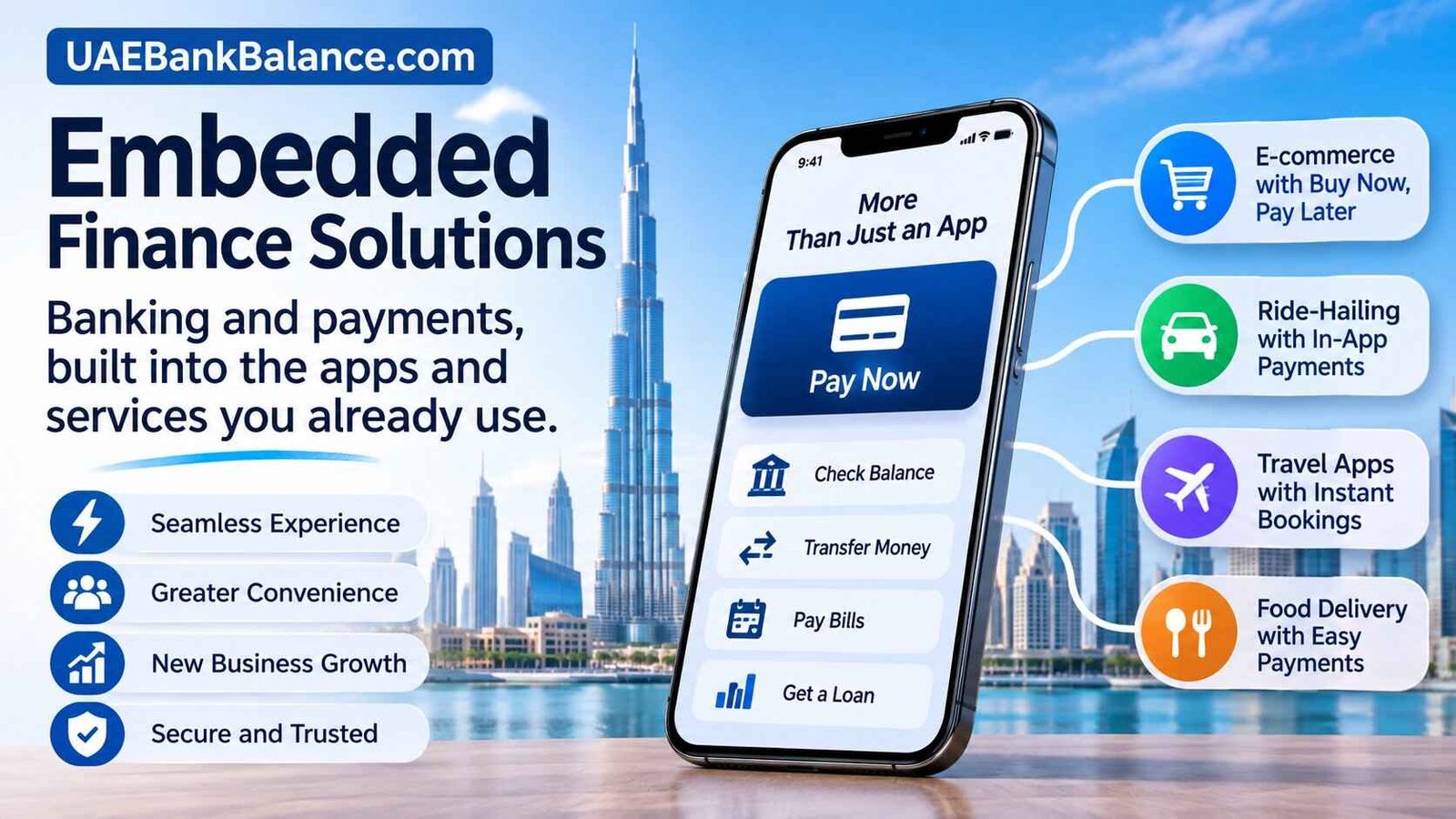
Embedded finance solutions are financial services built into a product that is not a bank, such as a shopping app, an accounting tool or a car dealer’s website. The platform shows the service, but a licensed bank, finance company or payment provider approves, holds or moves the money. You complete everything without leaving the platform.
Think of a delivery app that lets you pay from a wallet, or a retailer that offers instalments at checkout. The brand you see is the platform. The institution behind it checks your identity, decides on credit and moves the funds. The platform earns from the partnership, and the licensed provider carries the regulatory responsibility.
| Type | What it looks like in the UAE | Who usually runs the regulated part |
|---|---|---|
| Embedded payments | Card or wallet payment at an online checkout, or a payment gateway sold with a business account | Banks and licensed payment service providers |
| Embedded credit | Pay in instalments at checkout, or invoice financing inside a business platform | Finance companies with a Central Bank licence, banks, and licensed lenders |
| Embedded accounts and wallets | A spending account, prepaid card or wallet inside an app | Stored value facility licence holders and banks |
| Embedded insurance | Cover offered at the point of sale or inside a service app | Licensed insurers and brokers |
How does embedded finance work behind the scenes?
The platform connects to a licensed provider through an API, which is a secure link between two systems. Your request and details travel to the provider, which checks identity, fraud risk and affordability, then approves, declines or processes the payment. The platform controls what you see, but the provider holds the licence and the legal duties.
A typical journey looks like this:
- You choose a service on the platform, such as paying in instalments or getting a business advance.
- The platform sends your request to its partner.
- The partner verifies your identity, checks risk and applies its own terms.
- The partner approves or declines within seconds and moves the money through the banking system.
- Repayments, statements and complaints follow the partner’s terms, even though you started on the platform’s screen.
This split explains many customer service frustrations. The platform may not be able to change a repayment date or reverse a charge, because the provider controls the account. Read the terms to find the provider’s legal name.
Which embedded finance products are common in the UAE?
Checkout payments and business payment tools
Online merchants usually connect to a payment gateway or aggregator. The Central Bank defines payment aggregation as a service that lets e-commerce websites and merchants accept payment instruments without building their own payment integration, with the provider pooling the payments and passing them to the merchant after a period. That gap matters to small businesses, so ask how many days settlement takes.
Banks also bundle payments with business accounts. Mashreq, for example, advertises an extra AED 1,000 cashback and free ERP software for NEO BIZ customers who complete onboarding with NEO PAY, its POS and e-commerce gateway, subject to its terms and conditions.
Buy now, pay later
Buy now, pay later is the most visible form of embedded credit, and Tabby and Tamara are the best-known providers. Since the Central Bank’s Finance Companies Regulation took effect in December 2023, providers must be licensed as restricted licence finance companies or operate as agents of licensed banks or finance companies. Tamara received a restricted finance licence in October 2025.
Since July 2026, Tabby and Tamara account information also appears in credit reports from the Etihad Credit Bureau. Lenders can therefore see your repayment record, so late instalments can matter when you later apply for a credit card or loan.
Wallets, prepaid cards and spending accounts
A business that stores customer money needs a Stored Value Facilities licence from the Central Bank. Tabby received one in April 2026, which lets it hold customer funds and offer spending accounts, cards and money-management tools. If you use any wallet, find out who holds your balance and how you withdraw it.
Business financing inside other platforms
Invoice discounting and revenue-based financing now appear inside accounting, marketplace and ERP tools. Some lenders regulated in ADGM offer these through partner platforms. The platform makes the application quicker, but the lender sets the price. Compare the total cost with a bank loan before you accept.
Is embedded finance regulated in the UAE?
Yes. The provider behind the service must hold the right licence or be a licensed bank. Onshore, the Central Bank of the UAE regulates retail payments, stored value wallets, finance companies and open finance. A platform that promotes a licensed provider’s service on the provider’s behalf is not held liable under the payments regulation, but the provider must hold the licence.
| Activity | Main rule | What to check |
|---|---|---|
| Payments, merchant acquiring, payment aggregation, money transfers, payment initiation | Retail Payment Services and Card Schemes Regulation (Circular 15/2021, effective 6 June 2021) | The provider’s licence category, or its status as a licensed bank |
| Wallets, prepaid cards, stored value | Stored Value Facilities Regulation | A Stored Value Facilities licence |
| Buy now, pay later and short-term credit | Finance Companies Regulation (December 2023) | A restricted licence finance company, or agent status for a licensed bank or finance company |
| Sharing bank data and starting payments through apps | Open Finance Regulation (Circular 3/2025, in force from 10 July 2025) | Participation through Al Tareq |
The payments regulation lists nine retail payment services, including payment account issuance, merchant acquiring, payment aggregation, domestic and cross-border fund transfers, payment initiation and payment account information. It also bars anyone from providing or promoting these services without a Central Bank licence unless they are exempt. Licensed banks are deemed licensed, and finance companies are exempt only for issuing credit cards.
Firms in the DIFC are regulated by the DFSA, and firms in ADGM by the FSRA, so a provider based in a financial free zone follows those regulators. Descriptions of the Open Finance scheme say it applies onshore rather than in ADGM or DIFC, so ask a free-zone provider how it connects to onshore banks.
What does it take to become a licensed provider?
A business that wants to provide payment services itself needs a Central Bank licence in one of four categories. Initial capital runs from AED 100,000 for payment initiation and account information services up to AED 3 million for the broadest licence when monthly payment volume reaches AED 10 million or more. Most platforms skip this route and partner with a bank or licensed provider instead.
What are open finance and Al Tareq?
Open finance lets you share bank, insurance or other financial data with a licensed app and allows that app to start payments for you. In the UAE the Central Bank runs it through Al Tareq, and Nebras Open Finance operates the central API hub. Your consent must be explicit and recorded.
The rollout is phased. Banks and insurers came first, and other licensed institutions follow in a later phase. Banks began going live between late 2025 and early 2026. Abu Dhabi Islamic Bank announced its open finance services under Al Tareq on 21 January 2026, and Wio says Al Tareq is live for its customers.
Open finance matters for embedded finance because it gives apps a regulated way to read account information and start bank payments. A budgeting app or a business platform can show balances from several banks, or let you pay directly from your bank account, without handling your banking password.
What protections do you have as a customer?
If you use a Central Bank-licensed payment provider, the regulation gives you specific rights. They cover refunds for unauthorised transactions, advance notice of term changes, plain-language terms and protection of your data. Rules differ by licence type, and unlicensed providers offer none of these protections.
| Area | What the payments regulation says |
|---|---|
| Unauthorised transactions | The provider is liable unless you acted fraudulently or with gross negligence. It must refund by the end of the business day after it becomes aware of the transaction |
| Changes to terms | At least 30 calendar days’ notice. You can end the contract at no charge if you disagree |
| Language | Terms must be clear and plain, and available in Arabic and English on request |
| Statements | A written statement of transactions at least once a month, free of charge, under a framework agreement |
| Customer funds | Funds in transit must be segregated, held in escrow, or covered by a guarantee or insurance |
| Data | Personal and payment data must be stored in the UAE, with records kept for five years |
Report an unauthorised payment to the provider immediately, and keep screenshots and reference numbers.
How do you choose an embedded finance provider?
Start with the licence, then check who holds your money, how fast it settles and what every service costs. A reliable provider answers these questions in writing and has no problem showing its Central Bank status. If a platform cannot name the licensed partner behind its service, do not proceed.
| Check | Why it matters | A good answer |
|---|---|---|
| Licence | Only licensed providers can offer regulated services | A named Central Bank licence, or a licensed bank partner |
| Who holds the funds | Your money should be protected if the provider fails | Segregated accounts, escrow or a guarantee |
| Settlement time | Late payouts hurt cash flow | A stated number of working days and payout schedule |
| Fees | Hidden charges change the real cost | A written fee schedule covering every charge |
| Data and consent | You should control what is shared | Clear consent screens and a data policy |
| Integration | Poor tools cost development time | API documentation and a test environment |
| Support | Problems need fast answers | A named contact and Arabic and English support |
| Exit terms | You may need to switch providers | Clear notice periods and data export |
Red flags include promises of guaranteed approval, requests for your OTP or full card details, no named legal entity, and pressure to pay a fee before an account opens.
What does embedded finance cost?
Costs depend on the product and are often negotiated by business. Common charges include per-transaction fees, monthly platform fees, payout or settlement fees, refund and chargeback fees, and currency conversion charges. Ask for a written fee schedule that includes every charge before you sign.
For consumers, standard buy now, pay later plans are usually advertised as interest-free, but late fees, longer instalment plans and card fees can add cost. Read the terms before you pay, and check the total you will repay, not just the first instalment.
What are the risks and common mistakes?
The biggest risk is assuming that a trusted app means a regulated service. Embedded finance sits between a platform and a provider, and responsibility can blur. The table below separates common myths from the facts.
| Myth | Fact |
|---|---|
| The app I use is the lender | A licensed partner usually runs the credit. Look for its legal name in the terms |
| Instalment plans never reach my credit record | Tabby and Tamara accounts appear in credit reports from July 2026, so lenders can see them |
| A wallet balance is the same as a bank balance | A wallet provider holds it under a stored value licence. Check how funds are safeguarded and how you can withdraw them |
| Open finance gives apps access to everything | Access depends on your explicit, recorded consent and the data the app is licensed to use |
| A free zone company follows the same rules as an onshore one | Financial free zones have their own regulators |
Common mistakes include skipping the licence check, using several instalment plans at once, ignoring late fees, mixing personal and business payments in one wallet, and accepting a financing offer without comparing it with a bank loan.
Who should use embedded finance, and who should not?
Embedded finance suits businesses that want to sell faster, get paid sooner or offer customers flexible payment, and consumers who want a quick, clear checkout. It also suits small firms that want finance inside the tools they already use for invoicing and stock.
It is a poor fit when you cannot comfortably afford the repayments, when you need a large negotiated credit line, or when you need to talk to a named relationship manager. It is also worth pausing if the provider cannot explain how it protects your data and funds.
Where is embedded finance heading in the UAE?
Three trends are visible. Open finance is moving from rules to live use, with more banks and licensed providers joining Al Tareq. Buy now, pay later firms are widening into wallets, cards and accounts, as Tabby’s stored value licence shows. And finance is appearing inside more business tools, from accounting software to marketplaces.
For readers, that means more choice and more need to check who is behind each service. Licences, fees and rules change, so confirm details with the provider and the Central Bank before you act.
Final thoughts
Embedded finance makes paying, borrowing and saving faster, but the licensed provider behind the screen is the party that matters. Check its licence, find out who holds your money, read every fee and keep records of your transactions. We cover bank accounts, cards, credit scores and business banking in plain language at uaebankbalance.com, so you can compare options before you commit.
Frequently asked questions
What is an example of embedded finance in the UAE?
Buying something online and paying in instalments through Tabby or Tamara at checkout is the most common example. Using a wallet inside an app and getting invoice financing inside business software are others. In each case, a licensed provider runs the regulated service.
Is embedded finance the same as open banking?
No. Embedded finance puts a financial product inside a non-bank platform. Open finance lets you share financial data with licensed apps and lets them start payments. Embedded products can use open finance connections, but they are separate ideas.
Is embedded finance safe in the UAE?
It is safer when the provider holds a Central Bank licence and the terms are clear. Licensed payment providers must follow rules on refunds, data and fund protection. Risks remain, including scams, fees and overborrowing, so read the terms and use official apps.
Do embedded finance providers need a Central Bank licence?
Onshore, yes, for regulated activities such as payments, stored value wallets and short-term credit, unless the provider is a licensed bank. Providers in financial free zones follow the DFSA or FSRA instead. The platform that shows you the service may not hold the licence itself.
Does buy now, pay later affect my credit report?
Since July 2026, Tabby and Tamara account information appears in credit reports from the Etihad Credit Bureau. That means lenders can see your repayment history. Paying on time protects you, and late payments can affect later applications.
What is Al Tareq?
Al Tareq is the name of the UAE’s open finance initiative, which the Central Bank launched under its Open Finance Regulation. It lets licensed apps access your financial data and initiate payments with your consent. Nebras Open Finance runs the central API hub.
Can a small business offer embedded finance to its customers?
Usually it does so by partnering with a licensed bank or provider, not by becoming a provider itself. Providing payment services directly requires a Central Bank licence with initial capital from AED 100,000 to AED 3 million, depending on the category and volume. Check what the partner handles and what you remain responsible for.
What is banking as a service?
Banking as a service means a licensed bank or provider offers its accounts, payments or cards to other companies through an API. Those companies then build the product into their own app. The licensed provider remains responsible for the regulated activity.
How do I check whether a provider is licensed?
Find the provider’s legal name in its terms, then look for it on the Central Bank of the UAE licensing information. For financial free zones, check the DFSA or FSRA registers. If you cannot find the entity, contact the provider and ask for its licence details in writing.
Does embedded finance work in ADGM and DIFC?
Yes, but the rules come from the financial free zone regulators, not only the Central Bank. Descriptions of the Open Finance scheme say it applies onshore. Ask any free-zone provider which regulator supervises it and how it connects to onshore banks.
How much does it cost to integrate embedded finance?
The cost depends on the provider, the product and your transaction volume. Expect setup, per-transaction and payout charges, and ask for a full written fee schedule. Compare at least two providers before you sign.