
UAE Corporate Tax Guide (2026): Rates, Registration, Filing, FTA Compliance and Small Business Relief Until 2029
Since corporate tax began in the UAE, owners of mainland firms, free zone companies, freelancers and start-ups have all asked the same questions: Do I have to pay? Do I have to register? When do I file? And what happens if I get it wrong? The rules also changed in August 2026, when the government extended Small Business Relief until the end of 2029. This guide explains all of it in plain English, with dates, examples and a compliance checklist.
SAFETY NOTE: uaebankbalance.com is only an informational platform. We are not the Federal Tax Authority (FTA), the Ministry of Finance, a registered tax agent, an auditor or a legal adviser, and nothing here is tax, legal or financial advice. Tax rules, deadlines and penalties change, and your situation may differ. Always confirm with the FTA at tax.gov.ae, check the Ministry of Finance at mof.gov.ae, or speak to a registered tax agent before you register, file or pay. Register and file only through the FTA’s official EmaraTax portal, never share your login or OTP, and be careful with messages that threaten fines unless you click a link.
UAE Corporate Tax at a Glance (2026)
| Topic | Quick answer |
|---|---|
| Standard rate | 9% on taxable income above AED 375,000 |
| 0% band | Taxable income up to AED 375,000 |
| Who registers | Every taxable person, including free zone companies and businesses at 0% |
| Where to register and file | FTA’s EmaraTax portal |
| Return deadline | 9 months after the end of your tax period |
| Payment deadline | Same as the return deadline |
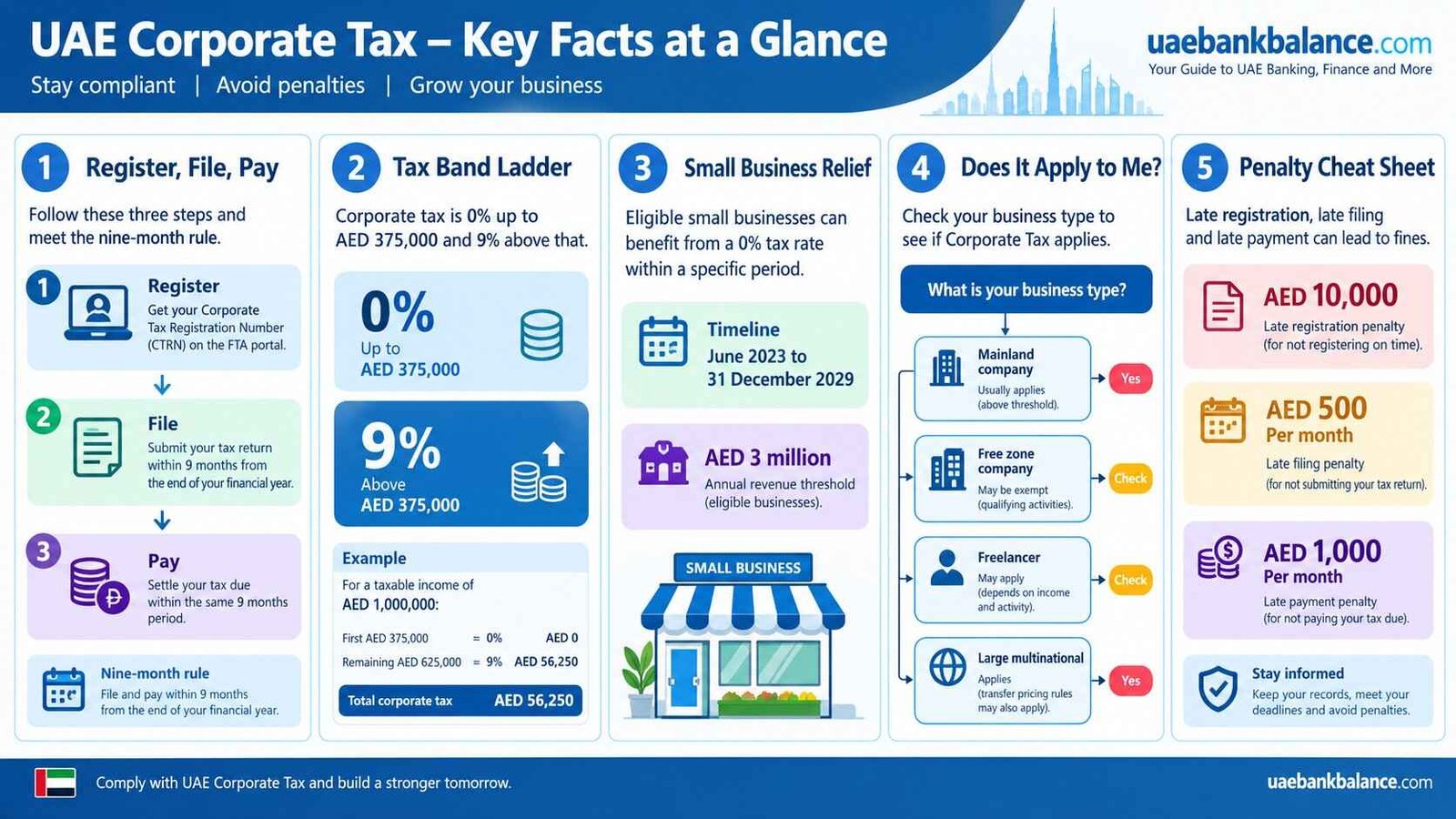
| Small Business Relief | Revenue up to AED 3 million, now available for tax periods ending on or before 31 December 2029 |
| Large multinationals | 15% Domestic Minimum Top-up Tax from 2025 |
| Personal income tax | None on salary, dividends or capital gains for individuals |
What Is UAE Corporate Tax?
UAE corporate tax is a tax on business profits, introduced by Federal Decree-Law No. 47 of 2022. It applies to financial years starting on or after 1 June 2023. It is not a tax on your salary. It applies to companies and to individuals only when they earn business income above a set turnover.
The key thing to understand: registering and filing are separate from paying. Many businesses owe 0% tax but still must register, keep records and file a return.
Who Has to Pay or Register?
- Mainland companies and other UAE legal entities: yes.
- Free zone companies: yes. They must register, and can get 0% only on qualifying income if they meet the conditions below.
- Freelancers, consultants and sole traders: individuals are generally taxed on business or business-related income only if their turnover in a calendar year exceeds AED 1 million. Salary, personal investment income and rental income of a personal nature are generally outside the net.
- Foreign companies: if they have a UAE permanent establishment or a nexus in the UAE.
- Exempt entities, such as certain government bodies, and some non-commercial sports entities: they may still need to register or file an annual declaration. Check your status.
UAE Corporate Tax Rates Explained
| Taxable income | Rate |
|---|---|
| Up to AED 375,000 | 0% |
| Above AED 375,000 | 9% |
| Qualifying income of a Qualifying Free Zone Person | 0% |
| Non-qualifying income of a free zone company | 9% |
| Large multinational groups (consolidated revenue of EUR 750 million or more) | 15% minimum effective rate through the Domestic Minimum Top-up Tax |
A simple example: a company has AED 1,000,000 of taxable profit. The first AED 375,000 is taxed at 0%. The remaining AED 625,000 is taxed at 9%, so the tax is AED 56,250.
Note that this is taxable income, not revenue. Taxable income starts from your accounting profit and is adjusted for items such as exempt income and non-deductible expenses.
Small Business Relief UAE Corporate Tax: Extended to 2029
What changed in 2026
On 7 August 2026, the Ministry of Finance announced Ministerial Decision No. 131 of 2026, which extends Small Business Relief to tax periods ending on or before 31 December 2029. The earlier cut-off was 31 December 2026, so businesses that were budgeting for 9% tax from 2027 now have three more years of relief. The AED 3 million revenue threshold did not change.
What the relief does
A business that elects for Small Business Relief is treated as having no taxable income for that tax period. That means no corporate tax, not just 0% on the first AED 375,000.
Who can claim it
The relief is for resident taxable persons whose revenue does not exceed AED 3 million, subject to the conditions in the legislation. Points to check with a tax adviser:
- It is not automatic. You must elect for it in your return on EmaraTax each year.
- You must still register and file, even when no tax is due.
- Free zone companies must choose between Small Business Relief and the free zone 0% regime for a given period. They cannot use both.
- Non-resident permanent establishments and large multinational groups are generally excluded.
- Trade-offs: while claiming relief, you are treated as having no taxable income, so you generally cannot carry forward tax losses from those periods.
How the 2029 date works in practice
The test is when your tax period ends, not when your business started.
| Tax period | Covered by the relief? |
|---|---|
| 1 Jan 2027 to 31 Dec 2027 | Yes |
| 1 Jan 2029 to 31 Dec 2029 | Yes |
| 1 Jul 2029 to 30 Jun 2030 | No, it ends after 31 Dec 2029 |
| 1 Jan 2030 to 31 Dec 2030 | No |
If your revenue will rise above AED 3 million in any year, plan for the 9% regime instead of assuming relief will always apply.
UAE Corporate Tax Registration
Every taxable person must register for corporate tax on EmaraTax and obtain a Corporate Tax Registration Number, even if they will pay 0%. Deadlines depend on your entity type and licence date. New companies generally need to register within three months of incorporation, and existing businesses followed deadlines set by the FTA based on licence month and turnover.
What you need: your trade licence, owner or shareholder details, an authorised signatory’s Emirates ID and passport, and your financial year end date. Registering on EmaraTax is free. Be wary of anyone charging extra for “special access”.
Late registration penalty: a fixed administrative penalty of AED 10,000 applies if you miss your deadline. The FTA introduced a waiver initiative that cancels or credits back the penalty if you file your first return within seven months of the end of your first tax period. The terms and dates of this initiative have been updated more than once, so check the latest conditions on the FTA website.
UAE Corporate Tax Filing: Deadlines, Steps and Documents
The deadline
Your return and any tax due must be filed and paid within nine months of the end of your tax period.
| Financial year end | Return and payment due |
|---|---|
| 31 December 2025 | 30 September 2026 (already passed) |
| 31 December 2026 | 30 September 2027 |
| 30 June 2026 | 31 March 2027 |
The FTA does not generally grant routine extensions, so plan to file early.
Step-by-step filing
- Close your books for the tax period and prepare financial statements.
- Calculate taxable income: start with accounting profit, then make the required adjustments.
- Gather supporting records: invoices, contracts, bank statements, ledgers and payroll records.
- Log in to EmaraTax and open the corporate tax return.
- Enter your figures and any elections, such as Small Business Relief.
- Review the return carefully, because errors can attract penalties.
- Submit and pay any tax due by the deadline.
- Keep a copy of the return and proof of payment.
Documents to keep ready
- Financial statements for the tax period (audited where required)
- General ledger and trial balance
- Sales and purchase invoices and bank statements
- Payroll records
- Related-party transaction details, if any
- Fixed asset register and loan agreements
Audit requirement: audited financial statements are required for Qualifying Free Zone Persons and for businesses with revenue above AED 50 million. Other businesses need proper accounts but not always an audit.
Record keeping: UAE businesses are expected to keep tax records for seven years. Confirm the current requirement with the FTA.
Free Zone Companies: How the 0% Rate Really Works
Being in a free zone does not make you tax-free. To be a Qualifying Free Zone Person and pay 0% on qualifying income, a company generally must:
- Maintain adequate substance (real staff, premises and activity) in the free zone
- Earn qualifying income from qualifying activities
- Meet the de minimis limit for non-qualifying revenue (the lower of AED 5 million or 5% of total revenue)
- Comply with transfer pricing rules
- Prepare audited financial statements
- Not elect to be taxed at the standard rate
If you breach the conditions, you can lose QFZP status and be taxed at 9% on all income, usually for several years. Qualifying activities lists were updated by newer decisions, so check the latest list before you plan.
UAE Corporate Tax Compliance With the FTA: Your Checklist
- Register on EmaraTax and keep your Corporate Tax Registration Number safe
- Keep accurate accounts and supporting documents for the required period
- File your return and pay tax within nine months of period end
- File even if you owe zero tax or are claiming Small Business Relief
- Disclose related-party transactions where required
- Correct mistakes quickly using the FTA’s process for errors
- Update your details on EmaraTax if your licence, address, shareholders or activities change
- File a deregistration application if you close your business
Penalties: What Mistakes Cost
Penalties vary by situation and the framework has been updated, so treat these as commonly cited examples and verify on the FTA website.
| Mistake | Commonly cited penalty |
|---|---|
| Late corporate tax registration | AED 10,000 (see the waiver conditions above) |
| Late return filing | AED 500 per month for the first 12 months, then AED 1,000 per month |
| Incorrect return | AED 500, unless corrected before the filing deadline |
| Late deregistration | Fixed penalties, rising per month up to a cap |
| Late payment of tax | Penalties and interest on unpaid tax |
If you find an error, correct it before the FTA contacts you, because voluntary corrections can reduce penalties.
Common Mistakes to Avoid
- Assuming “0% tax” means “no registration”
- Assuming Small Business Relief applies automatically
- Confusing revenue with taxable income
- Believing a free zone company is automatically exempt
- Waiting until the last week to file
- Mixing personal and business spending in the same account
- Not keeping receipts and contracts
- Ignoring a change in revenue that pushes you above AED 3 million
Frequently Asked Questions
What is the UAE corporate tax rate? 9% on taxable income above AED 375,000, and 0% up to that amount. Qualifying Free Zone Persons pay 0% on qualifying income. Large multinational groups face a 15% minimum rate.
Has Small Business Relief been extended to 2029? Yes. Ministerial Decision No. 131 of 2026 extends it to tax periods ending on or before 31 December 2029. The AED 3 million threshold is unchanged.
Do I have to file a corporate tax return if I qualify for Small Business Relief? Yes. You must register, file every year and elect for the relief in your return.
What is the UAE corporate tax filing deadline? Nine months after the end of your tax period. For a year ending 31 December 2026, that is 30 September 2027.
Where do I file my UAE corporate tax return? Only on the FTA’s EmaraTax portal.
What is the penalty for late corporate tax registration? A fixed AED 10,000 penalty, with a waiver initiative that has specific conditions. Check the FTA website for the latest terms.
Do freelancers pay corporate tax in the UAE? Generally only if their business turnover exceeds AED 1 million in a calendar year. Salary and personal investment income are outside the scope.
Do free zone companies pay corporate tax? They must register and file. Qualifying Free Zone Persons pay 0% on qualifying income and 9% on non-qualifying income, if conditions are met.
Do I need an audit for corporate tax? Audited financial statements are required for Qualifying Free Zone Persons and for businesses with revenue above AED 50 million.
Can I claim Small Business Relief and the free zone 0% rate together? No. A free zone company must choose one regime for a given period.
What is the 15% Domestic Minimum Top-up Tax? A minimum effective tax rate for large multinational groups with consolidated revenue of EUR 750 million or more, from financial years starting on or after 1 January 2025.
Is there a personal income tax in the UAE? No. There is no personal income tax on salary, dividends or capital gains for individuals.
Do I need a tax agent? Not always, but a registered tax agent or accountant can help if your accounts are complex, you are a free zone company, or you have related-party transactions.
Final Thoughts
UAE corporate tax is manageable once you separate the three jobs: register, file and pay. The August 2026 extension of Small Business Relief to 2029 gives small businesses breathing room, but only if they register, keep records and claim the relief correctly every year. When in doubt, check the FTA website or speak to a registered tax agent before the deadline, not after it.
Disclaimer: uaebankbalance.com is an informational platform and is not affiliated with the Federal Tax Authority, the Ministry of Finance or any government authority. Information is based on published sources as of 26 October 2026 and may change. It is not tax, legal or financial advice.