How to Get a Visa Credit Card in the UAE (2026): Eligibility, Documents and Step-by-Step Application
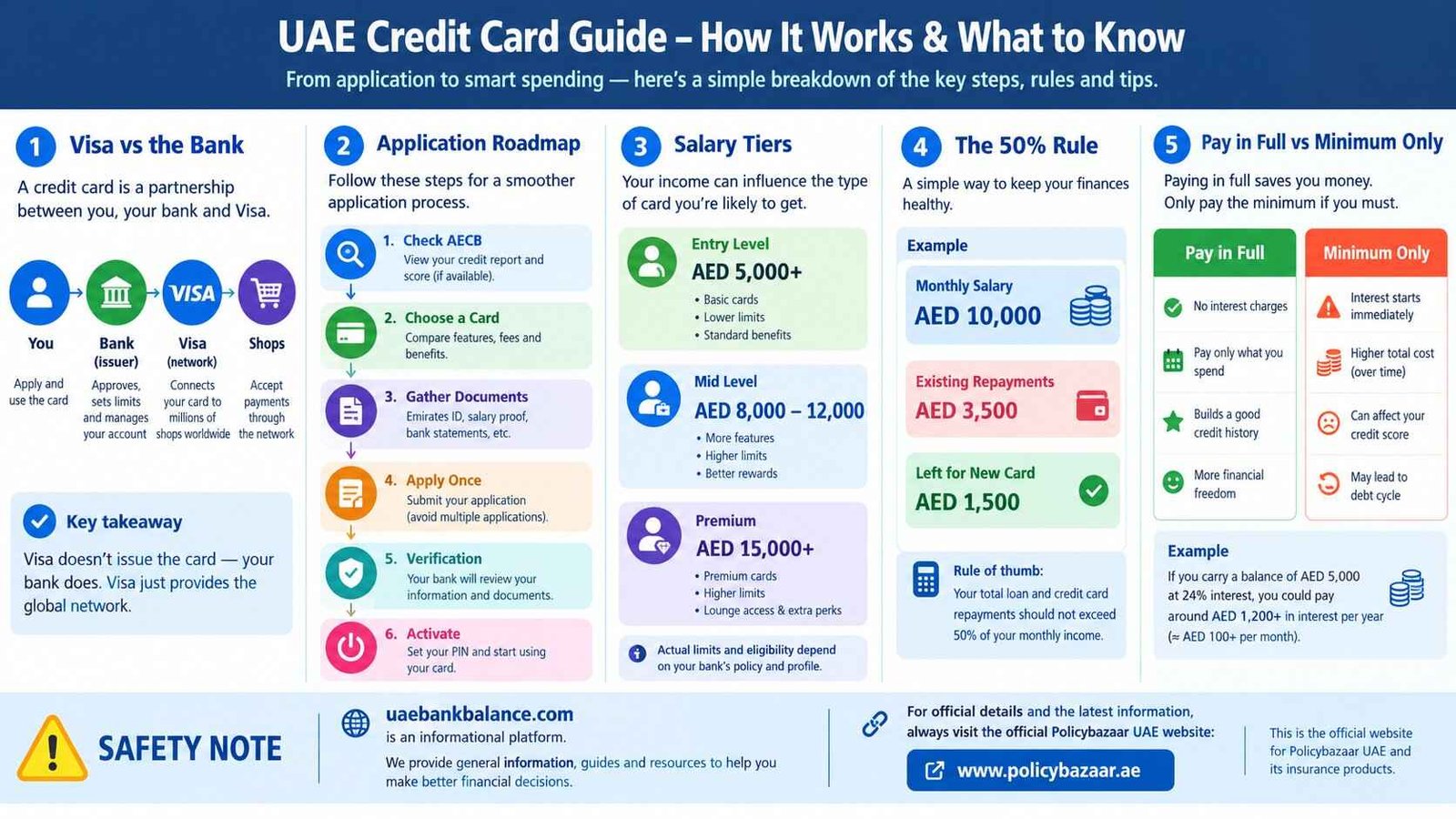
Many people search “how to get a Visa credit card” and assume they should apply to Visa. You cannot. Visa does not issue cards. A bank does, and the card simply runs on the Visa payment network. That one fact changes how you should approach the whole process. This guide walks you through eligibility, documents, the exact steps, how banks decide, what it costs if you slip up, and what to do if you are turned down.
SAFETY NOTE: uaebankbalance.com is only an informational platform. We are not a bank, a card issuer, a credit broker or a licensed financial adviser, and we are not affiliated with Visa or any bank mentioned here. Nothing on this page is financial advice. Card fees, rates and eligibility rules differ by bank and change often, so confirm everything with the issuing bank before you apply. For official rules on credit cards and consumer protection in the UAE, see the Central Bank of the UAE: centralbank.ae, and for your credit report, the Al Etihad Credit Bureau: aecb.gov.ae. Never pay an agent “to guarantee approval”, and never share your OTP, PIN, CVV or banking password with anyone.
Quick Answer: How to Get a Visa Credit Card in the UAE
- Check your AECB credit score and make sure your Emirates ID, visa and mobile number are valid.
- Choose a bank and card whose minimum salary you meet.
- Gather your documents: Emirates ID, passport, visa page, salary certificate, payslips or bank statements.
- Apply through the bank (app, website or branch), one card at a time.
- Wait for verification and approval, then activate the card and set up auto-payments.
What Does “Visa Credit Card” Actually Mean?
There are two parties in every card:
- The issuer is the bank (Emirates NBD, Mashreq, ADCB, RAKBANK and others). It approves you, sets your limit, charges your fees and interest, and sends the statement.
- The network is Visa or Mastercard. It processes payments and decides where the card is accepted and which network perks apply.
So when you compare cards, compare the bank’s terms and the card’s benefits first, and the network second. A Visa card from one bank can have very different fees, rewards and eligibility from a Visa card from another. Always read the card’s own page to see which network it runs on.
Who Can Get a Visa Credit Card in the UAE? (Eligibility)
Requirements vary by bank and card, but most banks look at the following:
| Requirement | What banks usually ask for |
|---|---|
| Age | Typically 21 or older, with an upper limit around 60 to 65 depending on the bank |
| Residency | A valid UAE residence visa and Emirates ID |
| Minimum income | Entry-level cards commonly start at AED 5,000 per month; higher tiers ask for more |
| Employment | Salaried or self-employed, usually with some time in your current job |
| Credit history | A satisfactory AECB credit report and score |
| Existing debt | Your total repayments must fit within the Central Bank’s debt burden limit |
Here is the rule most people never hear about. The Central Bank of the UAE requires that repayments on your credit facilities stay within 50% of your gross monthly income. If you earn AED 10,000 and already pay AED 3,500 a month on loans and cards, a new card’s minimum payment has to fit inside the remaining AED 1,500. Banks also tend to count unused card limits as potential debt, which is why holding many cards can block a new approval.
Typical salary by card tier
These are indicative figures from comparison sites, not guarantees. Each bank publishes its own number.
| Card tier | Typical minimum salary | What you usually get |
|---|---|---|
| Entry level | AED 5,000 and above | Everyday cashback or basic rewards, lower limits |
| Mid tier (Platinum or similar) | About AED 8,000 to 12,000 | Better rewards, cashback or travel perks, higher limits |
| Premium (Signature, Infinite, World) | About AED 15,000 to 25,000 or more | Lounge access, concierge, higher limits, travel insurance |
Tier names differ by bank. For more detail on salary thresholds, read our guide to the minimum salary for a credit card in the UAE.
Documents Required for a Visa Credit Card in the UAE
Keep clear, up-to-date copies of the following:
For salaried applicants
- Emirates ID (front and back)
- Passport copy, including the UAE residence visa page
- A recent salary certificate (many banks prefer one issued within the last month)
- Payslips and/or bank statements for the last 3 to 6 months
- UAE mobile number registered in your name
- Salary account IBAN, if the bank asks for it
For self-employed applicants
- Trade licence and company documents
- Business and personal bank statements, usually for 6 to 12 months
- Proof of income, as requested by the bank
Missing or mismatched documents are one of the most common reasons for delays. Make sure the name, employer and salary on your documents match your application exactly.
How to Apply: Step-by-Step
Step 1: Check your credit report and score
The AECB score ranges from 300 to 900, and a higher score means lower risk. Check it before you apply so you know where you stand. Errors on your report can hurt you, and you can ask for them to be corrected.
Step 2: Pick the right card, not just the right network
Decide what you want: cashback on everyday spending, travel rewards, fuel savings, or simply a no-fee card to build credit history. Compare the annual fee, finance charge, late fee, cash advance fee, minimum salary and the benefits that actually fit your spending.
Step 3: Confirm you meet the minimum salary
Applying for a card above your salary bracket usually just earns a rejection and a hard enquiry on your report.
Step 4: Prepare your documents
Use the checklist above and make sure nothing is expired.
Step 5: Apply through an official channel
You can apply through the bank’s mobile app or website, in a branch, or through a licensed comparison platform. If you are already a customer, the bank may show pre-approved offers inside its app. For example, Mashreq lists a credit card reward of up to AED 2,500 for new NEO customers who meet its spending criteria, which shows how banks sometimes tie rewards to new cards. Always read the full conditions.
Step 6: Apply for one card at a time
Each formal application triggers a hard enquiry on your credit report. Several applications in a short time can look like financial stress and lower your chances. If a bank rejects you, wait, fix the issue, and then try again.
Step 7: Verification and credit assessment
The bank pulls your AECB report, checks your income and employment, and may call you or your employer. Answer calls from the bank promptly and keep your phone available.
Step 8: Approval, limit and delivery
If approved, the bank sets your credit limit and issues the card. Timing ranges from minutes to several working days depending on the bank, the card and the completeness of your documents.
Step 9: Activate and set up safeguards
Activate the card, set a PIN, add it to Apple Pay, Google Pay or Samsung Pay if you like, and turn on SMS or app alerts. Set up automatic payment for at least the minimum amount, and ideally the full statement balance.
Can You Get a Visa Credit Card Without a Salary or With Low Income?
- Salary below AED 5,000: most mainstream banks will not approve a standard credit card. Alternatives include debit cards, prepaid cards and secured cards.
- Secured card: some banks offer a card backed by a fixed deposit you pledge as security. Under Central Bank rules, the total of any credit facility and card limit linked to a pledged deposit is capped at 50% of that deposit. Deposit sizes and terms vary by bank, so ask the issuer directly.
- New residents: you can apply once your Emirates ID and visa are active, but a bank may ask for a higher salary, a minimum time in your job, or a salary transfer to that bank.
- Self-employed: possible, but expect extra documents and stricter checks.
- Tourists and non-residents: a standard UAE credit card normally requires residency.
What Does a Visa Credit Card Cost? Know the Fees Before You Sign
A credit card is free only if you use it correctly. The Central Bank allows banks to charge no interest on purchases when the full statement balance is paid by the due date, but interest and fees apply otherwise. Cash advances are treated differently and can attract interest from the transaction date.
As an example of how high the cost can be, Emirates NBD’s published Key Facts Statement lists finance charges of up to 41.88% a year on retail purchases and cash advances, and a cash advance fee of 3.15% or AED 103.95, whichever is higher, with cash advances limited to 50% of the card limit on standard cards. Other banks charge different amounts, so always read the Key Facts Statement for the card you want.
Watch for:
- Annual fee (some cards are free for life or free with spending conditions)
- Finance charge on unpaid balances
- Late payment fee and over-limit fee
- Cash advance fee plus immediate interest
- Foreign transaction fee on overseas and online purchases in foreign currency
Banks must also warn you on your statement that paying only the minimum means paying more in interest and taking longer to clear your balance. Take that warning seriously.
Why Credit Card Applications Get Rejected (And How to Fix It)
Common reasons include:
- Income below the card’s minimum
- A low AECB score or past late payments
- Too many recent applications
- Existing debts that push you over the 50% limit
- Incomplete, expired or inconsistent documents
- Employment that is too new or with an unlisted employer
If you are rejected: ask the bank (or check your credit report) for the likely reason. Pay down existing balances, correct any errors, wait a few months, and then apply for a card that matches your profile, often an entry-level card or one from the bank where your salary is credited. Do not apply to several banks at once.
How to Improve Your Chances of Approval
- Pay every loan, card and bill on time
- Keep your salary credited to a UAE bank account regularly
- Avoid using most of your existing limits
- Close or avoid unnecessary cards and limits
- Apply for a card in your salary range
- Start with a bank where you already have a salary account, because they can see your income
- Keep your Emirates ID, address and mobile details up to date
Using Your First Visa Credit Card Wisely
- Pay the full statement balance every month, so you never pay interest on purchases.
- Keep your spending well below your limit. Using a small part of your limit is generally better for your score.
- Avoid cash advances. They are among the most expensive ways to borrow.
- Track the due date and use auto-pay.
- Check statements for unfamiliar charges and report them to your bank immediately.
- Think before upgrading or taking balance transfer or instalment offers. Read the fees first.
Beware of Credit Card Scams
Scammers target people who are looking for cards or loans. Be careful of anyone who:
- Promises guaranteed approval for a fee
- Asks for your OTP, CVV, PIN or online banking password
- Contacts you through WhatsApp or social media offering “pre-approved cards”
- Sends links that do not lead to the bank’s official website
Only apply through the bank’s own app or website, in a branch, or through a platform you have verified. If something feels wrong, call the bank using the number on its official site.
Frequently Asked Questions
Can I apply to Visa directly for a credit card? No. Visa is a payment network. You apply to a bank, and the bank issues a Visa card.
What is the minimum salary for a Visa credit card in the UAE? Many entry-level cards start at AED 5,000 per month, but each bank and card sets its own requirement.
Can I get a credit card with a AED 4,000 salary? Most mainstream banks will not approve one. You could look at debit, prepaid or secured card options.
Which documents do I need? Typically your Emirates ID, passport with visa page, a salary certificate, payslips or bank statements, and a UAE mobile number.
How long does approval take? It can range from minutes to several working days depending on the bank, the card and your documents.
Will applying for a credit card hurt my credit score? A formal application triggers a hard enquiry, which can have a small, temporary effect. Several applications in a short time can hurt more.
Can I get a Visa credit card without a salary transfer? Some banks approve cards without a salary transfer, but others prefer or require it. Check the card’s conditions.
Is a Visa credit card better than Mastercard? Neither is automatically better. The card’s fees, rewards and bank terms matter more than the network, though acceptance is wide for both.
How many credit cards can I have in the UAE? There is no fixed number, but every card limit counts toward your debt burden, which can limit new approvals.
Can I get a credit card as a new resident? Yes, if you meet the bank’s income, visa and document requirements, though some banks ask for a higher salary or time in your job.
What happens if I only pay the minimum? Interest is charged on the remaining balance, so you will pay more overall and take longer to clear the debt.
How do I cancel a credit card? Clear the balance and ask your bank to close it through its app, call centre or branch. Get written confirmation so no fees continue.
Final Thoughts
Getting a Visa credit card in the UAE is mostly about preparation: meet the salary and credit requirements, pick a card that suits your spending, apply once through an official channel, and use it responsibly. Pay in full each month and the card becomes a convenient tool. Pay only the minimum, and it becomes expensive fast.
Disclaimer: uaebankbalance.com is an informational platform and is not affiliated with Visa, any bank or any government authority. Information is based on published sources as of 21 October 2026 and may change. It is not financial, credit, tax or legal advice.