Personal Finance News This Week (UAE and World): Latest Developments, October 2026
Money news moves fast, but most readers only want to know one thing: does this affect my wallet? This week the answer is yes for many UAE residents. The US Federal Reserve and the UAE Central Bank have both raised rates, US inflation came in hotter than expected, and oil and gold are swinging. This page explains the biggest stories in plain language and tells you what each one means for your savings, loans and salary.
SAFETY NOTE: uaebankbalance.com is only an informational platform. We are not a bank, a broker, a licensed financial adviser, or a government body, and we are not affiliated with any bank mentioned here. Nothing on this page is financial, investment, tax or legal advice. Rates, fees and market prices change quickly, so always confirm the latest figures with your bank or an official source before you act. For official UAE interest-rate and banking information, visit the Central Bank of the UAE: centralbank.ae. Never share your OTP, PIN, card number or banking password with anyone, and be careful with messages that promise guaranteed returns or “instant loans”.
Top Financial News Today: 5 Headlines at a Glance
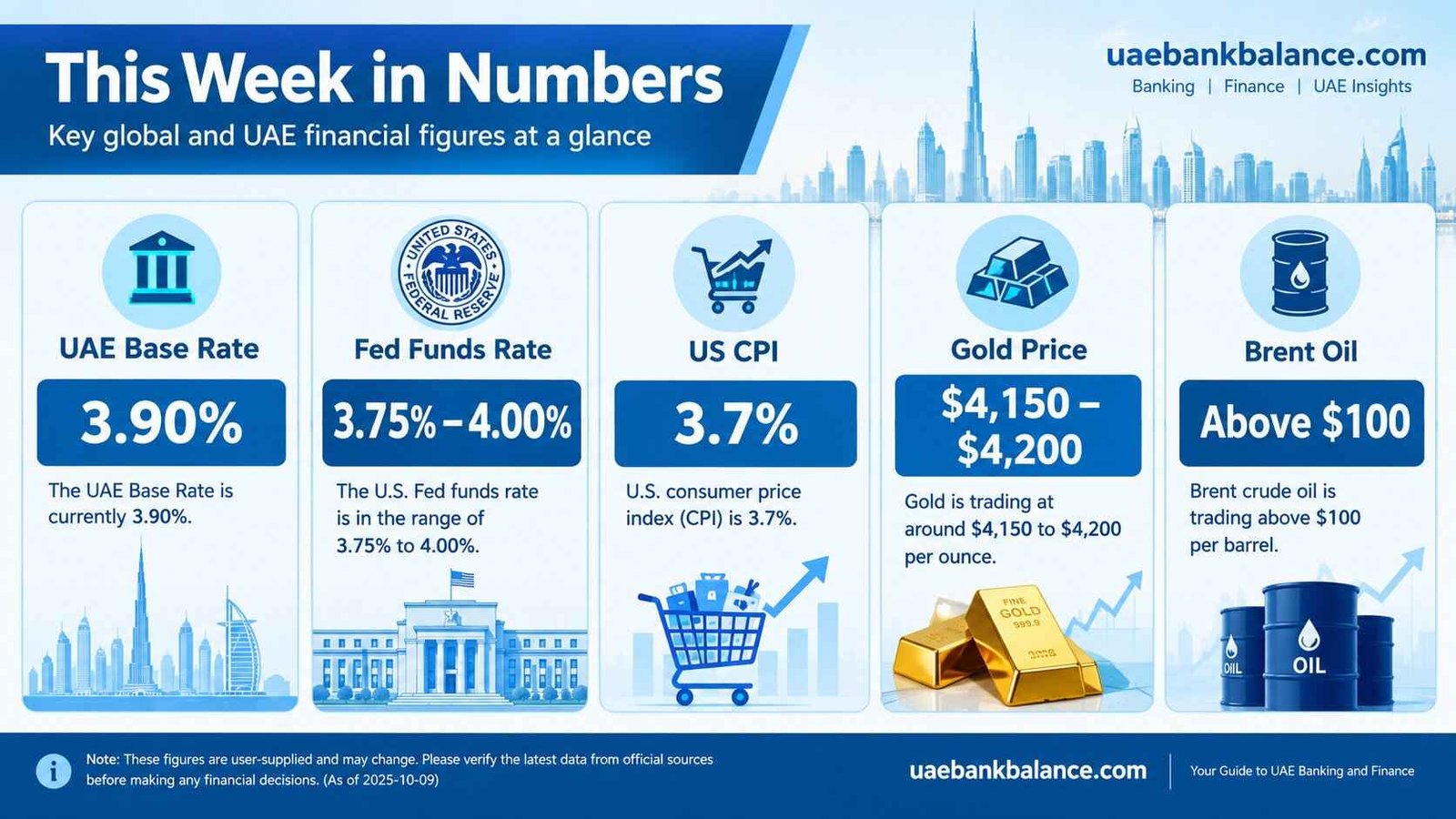
| Headline | The key number | What it means for you |
|---|---|---|
| UAE raises its base rate | 3.65% to 3.90% (effective 17 September) | Savers may see better returns first; variable-rate borrowers feel it later |
| US Federal Reserve hikes | Target range now 3.75% to 4.00% | Because the dirham is pegged to the dollar, UAE rates follow the Fed |
| US inflation heats up | 3.7% headline, 2.6% core (September) | Raises the chance of another hike |
| Oil stays high | Brent above $100, WTI in the mid-$90s | Keeps inflation worries alive worldwide |
| Gold slips from its highs | Around $4,150 to $4,200 an ounce | Higher rates make gold less attractive to some investors |
Personal Finance News: What the UAE Rate Rise Means for You
The headline
The Central Bank of the UAE raised its Base Rate by 0.25 percentage points to 3.90%, effective 17 September 2026. The move followed the US Federal Reserve’s decision to raise its own rate, its first increase in about three years. The UAE tracks the Fed because the dirham is pegged to the US dollar. The Central Bank’s website listed the Base Rate at 3.90% and overnight EIBOR at about 3.54% on 15 October.
If you have a mortgage
The effect is gradual, not instant. Here is how it works:
- Fixed-rate period: your instalment does not change until the fixed period ends.
- Variable rate (EIBOR-linked): many UAE home loans switch to EIBOR plus the bank’s margin after a fixed period. Your payment rises when the loan next resets.
- Off-plan buyers: the developer’s payment plan does not change, but the cost of a mortgage arranged at handover will depend on rates at that time.
One analyst estimated that a quarter-point rise adds roughly AED 210 a month to a AED 1.5 million mortgage with 25 years left, which is about AED 2,500 a year. Borrowers coming off fixed deals signed in 2020 and 2021 may see bigger jumps, because they locked in very low rates.
What to do: check your mortgage contract for the fixed period end date, the reset schedule and your bank’s margin. Ask your bank what your payment would be if rates rise another 0.25%.
If you save money
Analysts expect savers to benefit sooner than borrowers pay more, as banks adjust savings and fixed deposit rates. That makes this a good time to compare accounts. Remember that the highest advertised rates often depend on conditions such as salary transfer, minimum balances or withdrawal limits. For example, read our Mashreq NEO account guide and best savings accounts post to see how those conditions work in practice.
If you have a personal loan or credit card
Fixed-rate personal loans usually stay the same. Variable products and cards may reprice, so read your latest statement and check whether your rate is fixed or linked to a benchmark.
Finance News This Week: Latest Financial News in the World
1. US inflation came in hotter than expected
US consumer prices rose 3.7% in the 12 months to September, up from 3.4% in August. Core inflation, which excludes food and energy, rose to 2.6% from 2.4%. Gasoline prices jumped 7.1% in September. Markets reacted quickly: the chance of another Fed hike at its 27 to 28 October meeting jumped from about 22% to roughly 50%, depending on the source, and the US 10-year Treasury yield touched 5.33%. Some analysts still think the Fed will wait until December, so treat the odds as a guide, not a forecast.
2. The Fed is in a tough spot
The Fed raised rates in September to a range of 3.75% to 4.00% and signalled that more increases could follow. Inflation is above its 2% goal and energy prices are elevated. The next policy meeting on 27 to 28 October is the main date to watch.
3. Oil and Middle East tensions
Oil prices have stayed high, with Brent above $100 a barrel and US crude in the mid-$90s, as tensions in the Middle East raise supply worries. Higher energy costs feed into inflation, which is why they matter to central banks and to your grocery and fuel bills.
4. Gold pulls back
Spot gold traded around $4,150 to $4,200 an ounce this week. Gold has fallen by roughly a fifth from its earlier highs this year, as higher interest rates and a firmer dollar make a metal that pays no interest less attractive. It also tends to react sharply to US inflation data.
5. Stocks wobble
US shares fell after the inflation report, with the S&P 500 dropping about 0.8% on the day as bond yields rose. Investors are also asking how companies will pay for the huge spending on artificial intelligence, which is adding to the volatility.
Why this matters in the UAE: the dirham is fixed at 3.6725 to the US dollar, so American rate decisions quickly show up in UAE borrowing costs, savings rates and even the cost of imports.
Finance Industry News: How UAE Banks Are Doing
The Central Bank of the UAE’s September 2026 Quarterly Economic Review gives a snapshot of the banking industry. It reported that bank assets grew about 12.5% year on year, deposits grew about 14.0%, and lending grew about 18.1%, with asset quality continuing to improve in the second quarter of 2026. In plain terms, banks have more deposits to lend and more customers borrowing, and bad loans are not rising.
For you, this means competition for deposits and customers is strong, so it pays to compare accounts, fees, cashback offers and savings rates instead of staying with a default choice.
Corporate Finance News Today: What Businesses Should Watch
- Higher funding costs. Experts expect companies and SMEs with EIBOR-linked loans to see higher borrowing costs as rates reset. Firms with floating-rate debt should check their repayment capacity if rates stay high into 2027.
- Credit demand. Some analysts say higher rates may slow borrowing among small and highly indebted firms, but are unlikely to derail the UAE’s overall growth.
- Earnings, dividends and listings. Company results, dividend announcements and new share listings on the Dubai Financial Market and Abu Dhabi Securities Exchange are the usual drivers of corporate news. Check the exchanges’ official announcements for specific companies instead of relying on social media rumours.
Tip for business owners: ask your bank whether your facility is fixed or floating, when it resets, and whether you can fix part of the debt.
Interesting Finance News: 5 Facts That Surprise People
- The UAE does not set rates on its own. Because of the dollar peg, the Central Bank usually moves in step with the Fed.
- A tiny change adds up. A 0.25% rise can mean a few thousand dirhams a year on a large mortgage.
- Savers often win first. Deposit rates can respond faster than loan payments.
- Gold can fall when inflation rises. Because higher rates make non-yielding assets less attractive, gold does not always rise with inflation.
- Headline inflation and core inflation tell different stories. Energy can push the headline number up while the core number stays calmer.
Finance Articles for Students: How to Read the News Like an Analyst
If you are studying finance or economics, this week’s news is a free case study. Use this mini glossary:
| Term | Simple meaning | Where it shows up this week |
|---|---|---|
| Base Rate | The Central Bank’s key overnight rate | UAE moved to 3.90% |
| Dollar peg | The dirham is fixed to the US dollar | UAE rates follow the Fed |
| EIBOR | The rate banks charge each other in the UAE | Used to price many mortgages and business loans |
| Headline vs core inflation | Total price rise vs the rise excluding food and energy | US 3.7% vs 2.6% |
| Bond yield | The return investors demand on government debt | US 10-year touched 5.33% |
| Basis point | One hundredth of a percent | A 25 bp hike is 0.25% |
Try this exercise: a AED 1,000,000 mortgage over 25 years costs about AED 5,278 a month at 4%. At 4.25%, it costs about AED 5,417. The difference is roughly AED 139 a month, or around AED 1,670 a year. Now repeat it for AED 1,500,000 and compare your answer with the AED 210 estimate above.
How to build a good news habit: read the original source (central bank, exchange or company filing) before relying on a headline, check the date, and ask who benefits from the story.
What to Do This Week: A Quick Personal Finance Checklist
- Find out whether your mortgage or loan is fixed or variable.
- Compare your savings account rate with at least two alternatives.
- Review your emergency fund and aim to cover several months of expenses.
- Check your credit card statements for rate or fee changes.
- Avoid chasing “hot tips” on gold, crypto or stocks based on one headline.
- Bookmark the Central Bank of the UAE website for official rate announcements.
What to Watch Next
- 27 to 28 October: the Fed’s next policy meeting. A decision to hike again would likely be followed by a UAE Base Rate move.
- Oil prices and Middle East developments, which feed directly into inflation expectations.
- Bank announcements on savings rates, deposit rates and mortgage repricing.
Frequently Asked Questions
What is the UAE Base Rate today? The Central Bank of the UAE lists it at 3.90%, raised from 3.65% effective 17 September 2026.
Why does the UAE follow the US Federal Reserve? Because the dirham is pegged to the US dollar, the Central Bank keeps its Base Rate aligned with the Fed’s.
Will my UAE mortgage payment go up? It depends. Fixed-rate loans stay unchanged during the fixed period. Variable and EIBOR-linked loans can rise when they reset.
Will UAE savings rates go up? Analysts expect deposit rates to improve as banks adjust to higher funding costs, but each bank decides its own rates and conditions.
What is EIBOR? The Emirates Interbank Offered Rate, the rate banks charge each other for short-term loans. Many mortgages and business loans are priced off it.
Did US inflation go up or down? Up. Headline inflation rose to 3.7% in September from 3.4%, and core inflation rose to 2.6% from 2.4%.
Is gold going up or down? Gold has been volatile, trading around $4,150 to $4,200 an ounce this week and reacting strongly to inflation data. Prices change constantly, so check a live source.
Where can I read reliable finance news? Start with official sources such as the Central Bank of the UAE and the stock exchanges, then compare reputable news outlets.
How often is this page updated? We aim to refresh it weekly. Always check the “Last updated” date at the top.
Is this financial advice? No. This page is for general information only. Speak to a licensed adviser or your bank for decisions about your own money.
Final Thoughts
The big story is simple: rates are rising, inflation is not fully tamed, and energy prices are keeping central banks cautious. For UAE residents, that means savers may gain first, borrowers should plan ahead, and everyone benefits from comparing products. Check back each week for updates.
Disclaimer: uaebankbalance.com is an informational platform and is not affiliated with any bank, broker or government authority. Information is based on published sources as of 18 October 2026 and may change. It is not financial, investment, tax or legal advice.