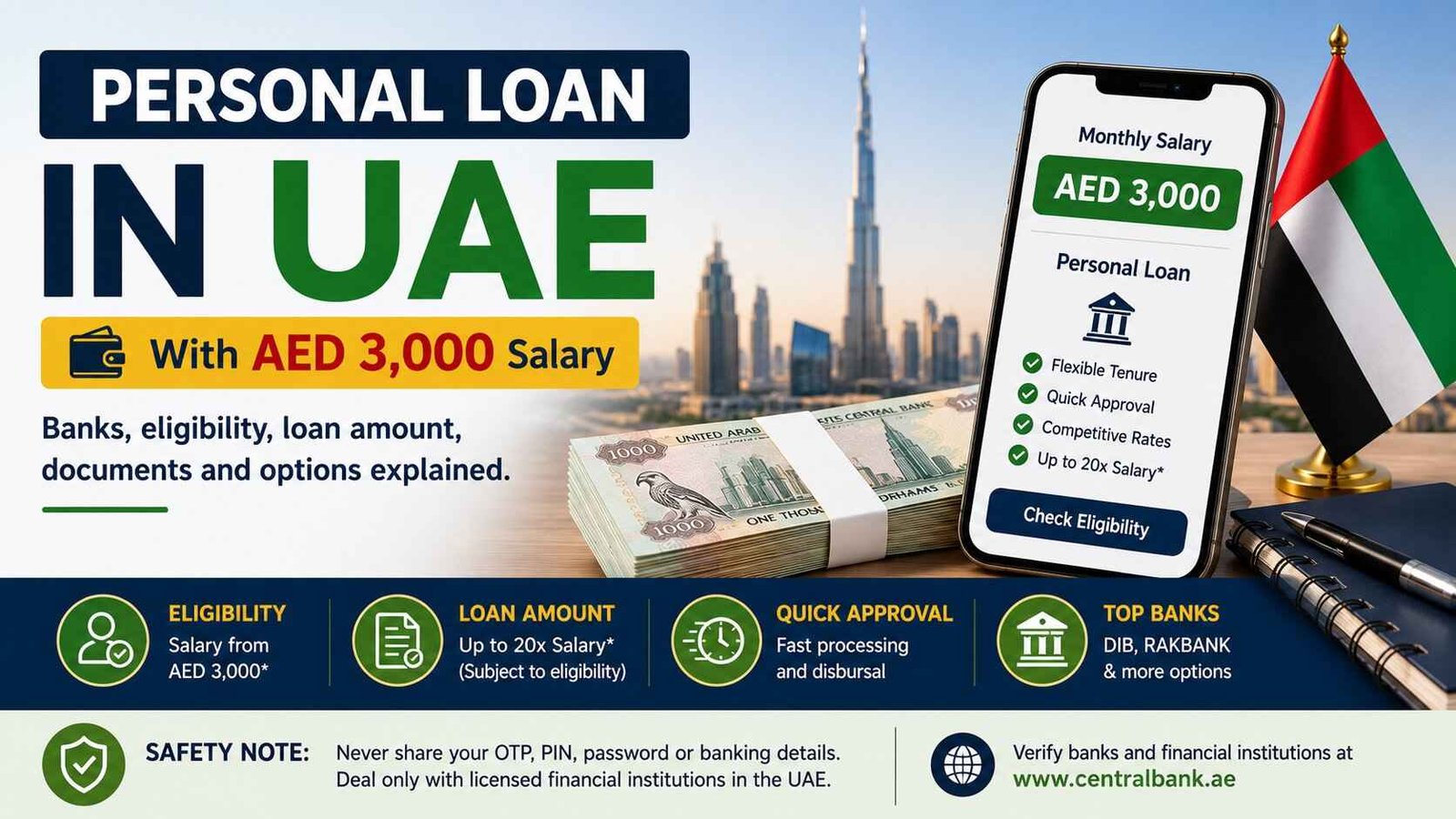
Personal Loan in UAE With AED 3,000 Salary: Banks, Eligibility and Options
Earning AED 3,000 a month can make borrowing in the UAE feel like a dead end. You may see personal-loan advertisements everywhere, but when you actually check the eligibility requirements, many familiar banks ask for a considerably higher salary. That leaves a very practical question: if your salary is AED 3,000, can you still get a personal loan in the UAE?
The answer is yes, in some cases. AED 3,000 is not a guarantee of approval, and it does not mean every UAE bank will accept your application. Some banks and financing products do publish a minimum salary of AED 3,000, while others have higher internal requirements. Your employer, salary transfer, existing debts, credit history and overall ability to repay can all affect the final decision.
Safety note: Never pay an unknown person an upfront “release fee” simply because they promise to arrange a personal loan. Verify the lender through its official website or the Central Bank of the UAE, and never share your OTP, PIN, CVV, password or online-banking credentials with anyone. For official consumer and banking information, check the Central Bank of the UAE.
Can You Get a Personal Loan in UAE With AED 3,000 Salary?
Yes, some personal-finance products in the UAE currently accept applications from customers earning AED 3,000 or more, but this is not the same as saying that everyone earning AED 3,000 qualifies.
For example, Dubai Islamic Bank currently states that its personal finance has a minimum salary starting from AED 3,000. Its published information also says the actual financing amount can depend on salary, eligibility and employer classification.
There is also an important distinction between different applicants.
A person earning AED 3,000 who works for an eligible employer, has a clean credit record and has few existing financial obligations may have a very different application outcome from someone earning exactly the same salary but already paying several loans or credit-card balances.
So the correct answer is:
AED 3,000 can be enough for some UAE personal-finance products, but salary alone does not guarantee approval.
Read More: Urgent Cash Loan in UAE
What Has Changed About the AED 3,000 Salary Requirement?
You may still see older UAE articles saying that a person needs at least AED 5,000 salary to obtain a personal loan.
That information should not automatically be treated as current.
The Central Bank of the UAE’s personal-loan rules set regulatory limits on the amount and repayment structure of personal loans rather than creating a universal bank-specific minimum salary of AED 5,000. Individual banks can establish their own eligibility policies.
This is why one bank may consider an applicant earning AED 3,000 while another bank may require AED 5,000, AED 7,000 or more.
The difference is important when searching for a personal loan in UAE with 3000 salary.
You should not assume that the lowest published salary requirement applies to every bank.
Which Banks May Consider a AED 3,000 Salary?
The number of options at this salary level is more limited than it is for someone earning AED 5,000, AED 7,000 or AED 10,000.
Two particularly important examples are DIB and RAKBANK, but their AED 3,000 options are not identical.
| Bank | AED 3,000 salary option | Important condition |
|---|---|---|
| Dubai Islamic Bank (DIB) | Yes, personal finance starts from AED 3,000 | Final eligibility depends on salary, employer and applicant profile |
| RAKBANK | Yes, for its UAE National Personal Loan | UAE Nationals, approved employer, salary transfer and other conditions |
| Many other UAE banks | Often higher published minimums | Check the specific product rather than assuming AED 3,000 is accepted |
Dubai Islamic Bank
DIB is one of the clearest mainstream examples for this salary range.
Its current personal-finance page states a minimum salary starting from AED 3,000, a maximum tenure of 48 months and quick processing. The bank also says the actual financing amount can vary according to salary, eligibility and employer classification.
DIB’s published documentation includes items such as a passport and residence visa for expatriates, Emirates ID, salary/end-of-service transfer documentation and, in some circumstances, bank statements.
This means someone earning AED 3,000 should not interpret the minimum salary figure as an automatic approval.
RAKBANK
RAKBANK has a personal-loan option with a minimum monthly salary of AED 3,000, but there is an important limitation: the product shown on its official website is specifically for UAE Nationals.
The bank states that applicants must be salaried, have at least three months of employment in their current job, work for an approved employer and transfer their salary to RAKBANK. It also states that a minimum AECB score of 300 applies to the product.
So an expatriate earning AED 3,000 should not look at this RAKBANK product and assume it is available to them.
This is exactly why low-salary loan searches require more than a simple list of bank names.
How Much Personal Loan Can You Get on AED 3,000 Salary?
This is one of the most common questions.
Under the CBUAE personal-loan regulation, the personal consumer loan limit is up to 20 times the borrower’s salary or total income, subject to the applicable rules. The repayment period must not exceed 48 months.
Using AED 3,000 simply as a mathematical example:
AED 3,000 × 20 = AED 60,000
So AED 60,000 is the regulatory calculation based on 20 times a AED 3,000 salary.
But this does not mean a bank must lend you AED 60,000.
That distinction is extremely important.
The actual approved amount may be much lower because the lender also considers affordability, existing liabilities, credit history, employer and other factors. The CBUAE’s own guidance says banks may decline to provide the full 20-times amount when a borrower has heavy commitments, lower disposable income or uncertain employment prospects.
AED 3,000 Salary Example
| Calculation | Amount |
|---|---|
| Monthly salary | AED 3,000 |
| 20 × salary | AED 60,000 |
| Regulatory maximum calculation | AED 60,000 |
| Guaranteed approved amount | No |
The AED 60,000 figure should therefore be treated as a regulatory ceiling calculation, not a loan offer.
What Is the Maximum Monthly Debt You Can Have?
The other important number is the Debt Burden Ratio (DBR).
The CBUAE states that the maximum DBR is generally 50% of gross salary and regular income from a defined and specific source.
For someone earning AED 3,000:
AED 3,000 × 50% = AED 1,500
This does not mean you should automatically take a loan with a monthly instalment of AED 1,500.
It means the regulatory limit on relevant total credit deductions is generally 50% of gross income.
That total can include existing credit commitments. The CBUAE rules specifically state that lenders must consider liabilities and ensure that total instalments, including credit-card payments, remain within the applicable limit.
If you already have:
- A car loan
- A personal loan
- Credit-card balances
- Other qualifying credit facilities
your available borrowing capacity can be considerably lower.
Why a AED 3,000 Salary Makes Loan Approval Difficult
The biggest problem is not necessarily the salary number itself.
It is affordability.
Someone earning AED 3,000 may have significant monthly expenses before a loan instalment is considered.
For example:
- Rent or accommodation
- Food
- Transport
- Mobile and internet
- Utilities
- Family support
- Existing loan payments
- Credit-card payments
- Insurance
- Other regular expenses
The lender therefore needs to determine whether the proposed financing would leave the customer with enough disposable income to manage normal living costs.
The CBUAE responsible-financing framework requires financial institutions to assess a customer’s ability to meet credit obligations and avoid excessive financial burden.
Does Salary Transfer Matter?
It can matter a lot.
Some personal-finance products require salary transfer to the bank.
RAKBANK’s UAE National Personal Loan, for example, explicitly requires salary transfer to RAKBANK.
DIB’s current personal-finance information is broader and states that financing can be available to customers who work for an approved company and transfer their salary to DIB, customers who transfer their salary elsewhere, and certain other customer categories, subject to the applicable conditions.
Therefore, if you earn AED 3,000, do not just ask:
“Which bank gives a loan on AED 3,000 salary?”
Also ask:
“Does that bank require salary transfer, and does my employer meet its criteria?”
Does Your Employer Matter?
Yes.
A minimum salary requirement is only one part of eligibility.
Banks can have approved-employer lists or employer-classification requirements.
For a lower salary such as AED 3,000, employer eligibility can become particularly important because the bank may have stricter risk criteria for lower-income applicants.
RAKBANK, for example, states that its AED 3,000 UAE National personal-loan applicants must work for an employer on its approved list.
DIB also notes that actual financing depends partly on employer classification.
What Documents Are Needed for a Personal Loan With AED 3,000 Salary?
Do not expect every lender to offer a “no-document loan.”
A legitimate financial institution still needs to establish your identity, income and eligibility.
DIB’s current personal-finance documentation includes:
- Passport, with residence visa for expatriates
- Emirates ID
- Salary and end-of-service-benefit transfer letter/certificate
- Bank statements where applicable
- Trade licence for relevant self-employed applicants
The exact list depends on your employment situation and whether you already bank with the lender.
If a website claims that it can provide a large personal loan to anyone earning AED 3,000 with “zero verification and no documents,” treat that claim very carefully.
Can Expatriates Get a Personal Loan With AED 3,000 Salary?
Potentially, yes, but the options are more limited.
DIB’s published personal-finance information lists a minimum salary of AED 3,000 for both UAE Nationals and expatriates. Its published maximum financing is up to AED 5 million for UAE Nationals and AED 3 million for expatriates, subject to eligibility and product conditions.
However, the maximum advertised financing amount is not relevant to most AED 3,000 earners.
At this income level, the more important questions are:
- Is your employer eligible?
- Is salary transfer required?
- Do you have existing loans?
- What is your credit history?
- How much can you realistically afford each month?
- What amount will the bank actually approve?
Can You Get a Personal Loan With AED 3,000 Salary Without Salary Transfer?
Sometimes, depending on the product.
DIB’s published personal-finance brochure says its Al Islami Personal Finance can be offered to certain customers who transfer salary to DIB, customers who transfer salary to another bank, and some self-employed customers, subject to the relevant conditions.
However, you should never assume that the AED 3,000 minimum applies in exactly the same way to every customer category.
Always check the current product conditions before applying.
What Credit Score Do You Need?
Your salary is only one part of the assessment.
Banks and financial institutions may check your credit record and other financial commitments when assessing an application.
A person with:
AED 3,000 salary + clean repayment history + low existing commitments
can have a different risk profile from someone with:
AED 3,000 salary + several existing debts + missed payments.
The CBUAE requires lenders to assess the customer’s credit record and ability to meet monthly credit obligations as part of responsible lending.
Do not believe websites that promise approval simply because your salary reaches AED 3,000.
What Loan Amount Should You Actually Apply For?
The maximum amount you can theoretically qualify for is not necessarily the amount you should borrow.
This is especially important at a AED 3,000 salary.
If you only need AED 10,000 for a specific expense, borrowing AED 50,000 simply because a lender says you may qualify for a larger amount can put unnecessary pressure on your monthly budget.
Before applying, calculate:
Amount actually needed → monthly instalment → total repayment → remaining monthly income
A smaller loan with a manageable repayment can be safer than taking the largest amount available.
Personal Loan vs Urgent Cash Loan With AED 3,000 Salary
If you are searching because you need money urgently, you may also encounter advertisements for:
- Instant cash loans
- Emergency loans
- Same-day loans
- Salary advances
- Loans without documents
- Quick personal loans
These terms can refer to different products.
Do not assume that an “instant loan” is automatically a better option than a conventional personal-finance product.
Check:
| What to compare | Why it matters |
|---|---|
| Approved amount | You may receive less than requested |
| Monthly payment | Shows the immediate budget impact |
| Total repayment | Shows the overall cost |
| Processing fee | Adds to borrowing cost |
| Interest/profit rate | Affects the cost of financing |
| Tenure | Longer repayment can increase total cost |
| Salary transfer | May be mandatory |
| Employer eligibility | Can affect approval |
| Credit assessment | Determines whether you qualify |
What If You Are Rejected With a AED 3,000 Salary?
Do not immediately apply everywhere.
First find out whether the problem was:
- Salary below the bank’s minimum
- Employer not on the approved list
- Existing debt
- Credit history
- Insufficient affordability
- Employment length
- Documentation
- Salary-transfer requirement
- Internal bank policy
If the issue is affordability, applying to multiple lenders may not solve it.
You may be better off reducing existing obligations, waiting until your financial position improves, or considering whether you need the full amount you originally requested.
Are There Personal Loans for AED 3,000 Salary in Dubai and Abu Dhabi?
The location itself is not necessarily the deciding factor.
A borrower living in Dubai may apply to a bank headquartered in Abu Dhabi, while someone living in Abu Dhabi may use a bank with branches across the UAE.
What usually matters more is:
- Bank/product eligibility
- Salary
- Employer
- Residency
- Existing liabilities
- Credit profile
- Salary transfer
- Repayment capacity
Therefore, searching separately for “personal loan in Dubai with AED 3,000 salary” or “personal loan in Abu Dhabi with AED 3,000 salary” does not automatically mean there will be different salary rules.
Be Careful With Low-Salary Loan Scams
A lower income can make people particularly vulnerable to advertisements promising easy approval.
Be cautious if someone claims:
“AED 3,000 salary? Guaranteed AED 100,000 loan.”
Or:
“No documents. No credit check. Pay AED 500 first and your loan will be released.”
These are serious warning signs.
Never send money to an unknown person simply because they claim to arrange a bank loan.
Never provide:
- OTP
- ATM PIN
- Card PIN
- CVV
- Online-banking password
- Banking-app login
- Full card details
Use the lender’s official website or customer-service channel to verify the offer.
Is AED 3,000 a Good Salary for Taking a Personal Loan?
That depends on your expenses and existing commitments.
A personal loan can make sense for a necessary expense when the repayment is comfortably affordable.
But if most of your AED 3,000 salary is already committed to rent, food, transport, family support and existing debt, adding another monthly payment can create a serious financial strain.
The fact that a bank can approve a loan does not necessarily mean that taking the loan is financially comfortable.
That distinction is worth remembering.
What Is the Best Personal Loan for AED 3,000 Salary?
There is no single “best” loan for everyone earning AED 3,000.
For a UAE National, a product such as RAKBANK’s UAE National Personal Loan may be relevant because the bank currently publishes a AED 3,000 minimum salary, subject to conditions including salary transfer and approved-employer requirements.
For eligible UAE residents, DIB is another important option to investigate because its current personal-finance information starts at AED 3,000.
But the best option should be determined by:
Eligibility + total cost + monthly repayment + salary-transfer requirements + your actual financial need.
Do not choose a loan simply because it advertises the lowest salary requirement.
People Also Ask
Can I get a personal loan in UAE with AED 3,000 salary?
Yes, some UAE personal-finance products currently start at AED 3,000. However, the minimum salary does not guarantee approval. Eligibility can also depend on your employer, credit history, existing obligations and repayment capacity.
Which bank gives a personal loan with AED 3,000 salary?
DIB currently publishes personal finance starting from AED 3,000. RAKBANK also publishes a AED 3,000 minimum for its UAE National Personal Loan, subject to specific conditions.
How much loan can I get with a AED 3,000 salary?
The CBUAE personal-loan regulation sets a maximum loan amount of 20 times salary or total income. For AED 3,000, that mathematical ceiling is AED 60,000. However, this is not a guaranteed approved amount; the bank can approve less based on affordability and its lending criteria.
Can I get AED 50,000 loan on a AED 3,000 salary?
It is not possible to say that you will qualify for AED 50,000 based on salary alone. The lender must assess your overall affordability, existing obligations, credit record and other eligibility conditions.
Can an expatriate get a personal loan with AED 3,000 salary?
Potentially. DIB currently publishes a AED 3,000 minimum salary for personal finance and provides financing options for expatriates, subject to eligibility.
Does a AED 3,000 salary qualify for a personal loan without salary transfer?
Some products may accept customers without salary transfer, but the conditions vary. DIB’s published information includes customer categories that can transfer salary to another bank, subject to its criteria.
Is a AED 3,000 salary enough for an instant loan?
Not automatically. An advertised instant or fast application does not guarantee approval. The lender still needs to assess eligibility and affordability.
Can I get a personal loan if I already have credit-card debt?
Possibly, but existing credit-card obligations can affect your debt-burden calculation and borrowing capacity. The CBUAE requires lenders to consider existing credit obligations when assessing repayment ability.
Frequently Asked Questions
What is the minimum salary for a personal loan in the UAE?
There is no single salary figure that applies to every bank and personal-finance product. Individual financial institutions set their own eligibility criteria. Some current products start at AED 3,000, while other banks require more.
Is AED 3,000 considered a low salary for a UAE personal loan?
It is at the lower end of the salary range for many mainstream personal-loan products. That means the number of available options can be smaller and affordability requirements can be more important.
Does a bank have to approve my loan because I earn AED 3,000?
No. A published minimum salary only means you may meet one eligibility condition. The bank can consider credit history, employer, existing debts, salary transfer and repayment capacity before making a decision.
Is AED 60,000 guaranteed on a AED 3,000 salary?
No. AED 60,000 is simply the result of multiplying AED 3,000 by the CBUAE’s 20-times personal-loan limit. It is not a guaranteed loan offer.
What should I check before taking a low-salary personal loan?
Check the monthly instalment, total repayment, profit or interest rate, processing fee, salary-transfer requirement, early-settlement conditions and any other applicable charges.
Final Takeaway
A personal loan in UAE with a AED 3,000 salary is possible in some cases, but it is not as simple as finding a bank that displays “AED 3,000 minimum salary.”
Current DIB information confirms that personal finance starts from AED 3,000, while RAKBANK has a AED 3,000 personal-loan option specifically for UAE Nationals with additional conditions.
For a AED 3,000 salary, the CBUAE’s 20-times personal-loan limit gives a mathematical maximum of AED 60,000, but that does not mean a borrower will receive AED 60,000. Existing debts, credit history, employer, salary-transfer arrangements and affordability can all reduce the amount or result in rejection.
If you are earning AED 3,000, the smartest approach is to look beyond the advertised maximum. Compare the actual monthly instalment and total repayment with your existing expenses before borrowing.
A loan that fits your salary on paper may still be uncomfortable in real life.