UAE Bank Sharia Non-Compliance Fine: What It Means for Customers (2026)
If you’ve recently seen news about a UAE bank receiving a Sharia non-compliance fine, it’s natural to wonder whether your savings, salary, Islamic bank account, or debit card could be affected. Headlines often mention regulatory penalties but rarely explain what they actually mean for everyday customers.
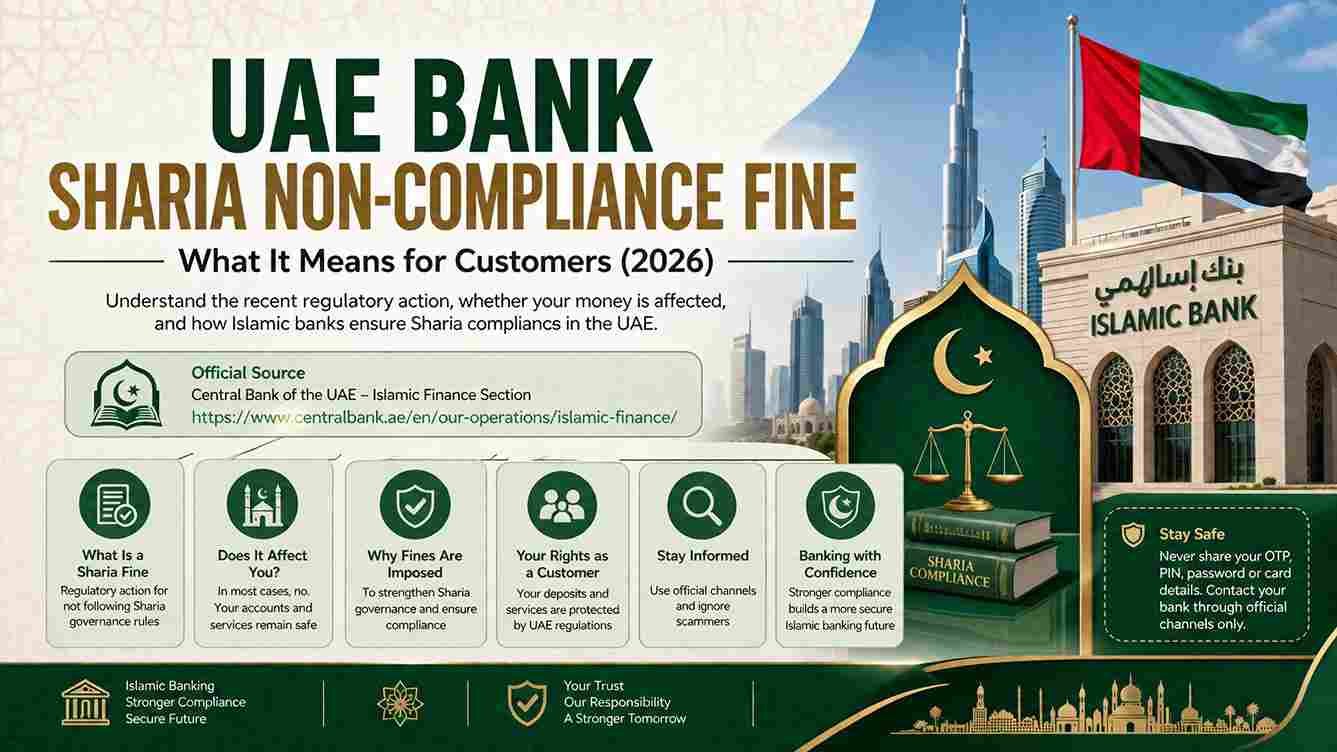
The good news is that, in most cases, these regulatory actions do not affect customer deposits, salary payments, ATM withdrawals, online banking, or mobile banking services. Instead, they are supervisory measures taken by the Central Bank of the UAE (CBUAE) when an Islamic bank or an Islamic banking window fails to fully comply with the country’s Sharia governance requirements.
This article on Uaebankbalance.com explains the topic in simple language, helping you understand why these fines are issued, whether you should be concerned, what your rights are as a customer, and how Islamic banks maintain Sharia compliance in the UAE.
Official Source: The Central Bank of the UAE has established a comprehensive Higher Sharia Authority and Sharia Governance Framework that all licensed Islamic financial institutions must follow. Official information is available at: https://www.centralbank.ae/en/our-operations/islamic-finance/
What Is a Sharia Non-Compliance Fine?
A Sharia non-compliance fine is a regulatory enforcement action that may be imposed by the Central Bank of the UAE (CBUAE) if an Islamic financial institution fails to comply with the UAE’s approved Sharia governance framework or related regulatory requirements.
Islamic banks must ensure that their banking products, financing contracts, investments, and operational processes comply with Islamic finance principles approved by qualified Sharia authorities. In addition to providing banking services, they are legally required to maintain strong governance systems, internal controls, compliance procedures, independent reviews, and proper documentation.
If a regulatory inspection identifies shortcomings in these areas, the Central Bank may require the institution to correct the issue and may also impose administrative penalties depending on the seriousness of the violation.
It is important to understand that these penalties are directed at the financial institution—not at its customers. Their purpose is to strengthen governance, improve compliance, and maintain confidence in the UAE’s Islamic banking system.
What Is Sharia Compliance in Islamic Banking?
Sharia compliance means that an Islamic bank conducts its banking activities according to Islamic finance principles while also complying with UAE banking regulations.
Unlike conventional banks that primarily use interest-based lending, Islamic banks structure many financial products using approved Islamic contracts such as Murabaha, Ijara, Musharaka, Mudaraba, and Wakala. Every Islamic banking product must undergo a review process before being offered to customers.
To remain compliant, Islamic banks generally maintain:
- An independent Sharia Supervisory Committee.
- Internal Sharia compliance departments.
- Regular Sharia audits.
- Risk management systems.
- Compliance monitoring.
- Internal governance controls.
- Regulatory reporting procedures.
These safeguards help ensure that banking products continue to meet both regulatory and Sharia governance standards.
Does the Fine Affect Your Money?
This is the question that concerns most customers.
In almost all cases, the answer is no.
A Sharia non-compliance fine issued against a bank does not automatically mean that customer deposits, salaries, savings accounts, or debit cards are at risk.
Customers can usually continue using:
- Savings accounts.
- Current accounts.
- Salary accounts.
- ATM services.
- Mobile banking.
- Internet banking.
- Debit cards.
- Local and international transfers.
- Bill payment services.
Unless the Central Bank announces specific operational restrictions—which is uncommon for routine regulatory actions—customers generally experience no interruption in normal banking services.
Why Would a Bank Receive Such a Fine?
Every regulatory case is different, and the Central Bank does not always publish every operational detail. However, enforcement action may arise when regulators identify weaknesses in areas such as:
- Sharia governance procedures.
- Internal compliance controls.
- Documentation standards.
- Regulatory reporting.
- Internal audit findings.
- Governance oversight.
- Implementation of approved Sharia policies.
Receiving a regulatory fine does not necessarily indicate fraud, financial instability, or customer losses. Instead, it often reflects the regulator’s effort to ensure that banks continuously improve their governance and compliance systems.
Safety Note
Safety Note: Whenever news about a bank penalty becomes public, fraudsters sometimes attempt to exploit customers by pretending to represent the bank or the Central Bank. Neither the Central Bank of the UAE nor any licensed bank will ever ask you to share your OTP (One-Time Password), ATM PIN, online banking password, CVV, or full debit/credit card details by phone, WhatsApp, SMS, or email. If you receive such a request, do not respond. Contact your bank using the customer care number printed on the back of your card or through its official website or mobile app.